Wednesday, January 18, 2012

If I Ruled The World

I'd make every radio owner, manager and programmer sign up for Pandora and spend thirty minutes per day with it and then switch over to their stations' online stream.

One of the two will captivate you with its flow and consistency and the other will treat you to clipped songs, the same Ad Council PSA's over and over, a time delay which makes it impossible to win their contests and promotions, technical glitches and snags.

With one, the two quarter hours will will seem to speed by and you might even forget to turn it off.

With the other, you'd likely become so frustrated with the experience that you'll probably switch it off early.

Aren't we supposed to be the "TSL" experts?

Tuesday, January 17, 2012

Be An Operator, Not A Trader In 2012

As both savvy Inside Radio scribes Paul Heine and Frank Saxe reported yesterday that the "deal market (is) still struggling to find its legs" and "... the radio industry is entering its fifth year since the task of either buying or selling a station became much more difficult following a reset in pricing and the exit of many media lenders," they also made the statement that "the buying and selling of stations is seen by many as a barometer of the radio industry’s health."

Really? Is that all there is?

Let's get back to business basics and rethink that

Entertaining, informing, interacting with and engaging listeners as a means to aggregating a large, loyal audience, creating memorable events across multiple analog and digital platforms, leading to the buying and selling time with those folks is an even better barometer of the radio industry's sustenance and health.

Advertising helps the whole economy.

Radio, done right, is still a terrific business.

Rather than trading in our hard assets and stick values, lets sell the thing we have a fresh new supply of every day: time.

That way, we'll still be around, creating jobs and building profits, in 2013.

Monday, January 16, 2012

The "Other" Questions

This is the week A&O's 7th Annual "Roadmap 2012" perceptual study goes into the field. Client stations can track strategic and tactical questions to define clusters (in addition to music preference), understand how satisfied each individual audience is with their favorite station compared to national averages, tracked over the years, in addition to tech usage.

Each A&O client station will receive a customized local breakout. The first presentation of the national findings and recommendations will be at A&O Pre-CRS Seminar '12 next month.

It's never possible to have an unlimited number of questions. That's why as Mike, Becky and I finalize the study, we ask ourselves "are these the most pressing success factors affecting clients right now?," which means that there are many other "interesting" things everyone who creates content for listeners also need to know about today's listener which we decided not to ask, since any smart programmer or personality is going to hang out with real people in their audience and tailor what they talk about to as many tribes within their cume as possible.

Do you know how long your cume and core listeners have been listening to country music? Less than a year, 1 to 3 years, 3 to 6 years, more than 6? The exact percentages matter less to your success than the fact that a bit of your content must be engaging to each of those groups as consistently as possible.

How many folks under 30 live in their residence? Is it close to the national census average of two and a half? More/fewer? Why would that be? Is it unique to your station or the local community for some reason?

Besides country music, what other types of music do they enjoy listening to? What type of program do they like to watch on TV?

In the past year, how many times have they left your home state on vacation? Did they drive or fly?

If they could choose one place to go on a dream vacation, where would it be? Would they take the whole family or go alone for an escape?

When they have spare time, what type of activity do they like to do most often?

How many vehicles do they and the other members of the household own?

Is their personal vehicle domestic or foreign? Why?

How would they identify their political views?
Republican/conservative
Democrat/liberal
Independent
Other

Social networks are one great place to start to think about these "lifestyle" questions in terms of the kind of people you want to like and listen regularly to you, and I don't just mean Facebook, Twitter and the online resources where you can interact with the lives of real people.

You don't need a perceptual study to do that.

You need a "life."

PS: if you'd like to make sure your audience is part of "A&O Country Roadmap 2012," reach out now to Mike, Becky or me.

Saturday, January 14, 2012

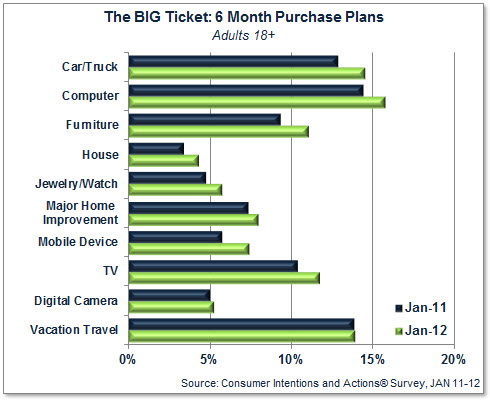
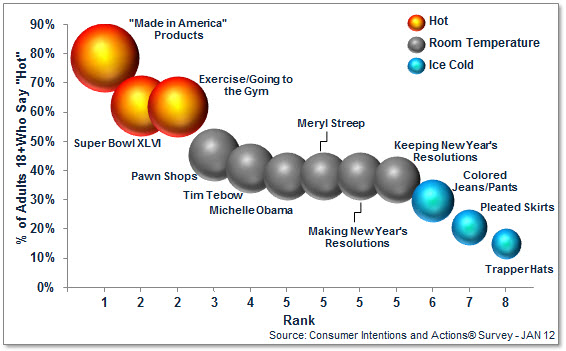
Is "Spending Hibernation" Coming To An End?

If you've been reading this blog for very long, you know I always look forward to the monthly tracking studies from Phil Rist at Big Research, not only for sales and business reasons but also because they provide great insights for promotions and marketing as well.

Hot buttons for on air giveaways and content: USA pride, Superbowl and of course that annual resolution to lose weight and get in better shape. But: don't do it in colored jeans, a pleated skirt or trapper hat.

Thursday, January 12, 2012

Interesting Times

For example..

1. A fast-growing ownership group learned yesterday from Miller-Kaplan that they have gone - in just four years - from buying a market's lowest-billing cluster to becoming that city's top-biller in 2011, but still had to work with their lenders to enter bankruptcy because they had the bad timing to have purchased the stations the year before the financial crash of '08.

Going from worst to first in revenues was still not enough to pay the bankers, who - thankfully - cooperated in the restructuring.

2. A longtime major market programmer and air talent who went into music promotion a few years ago lost his job this week when his label owners eliminated their entire promotion staff.

I told him about an on air position with a great company that just opened, but he declined my offer of a recommendation, preferring to continue to pursue work in the record business.

At least he knows where his passion lives and when times are tough, that's the name of the game.

3. Toby Keith's "Red Solo Cup" has sold 1,023,617 digital tracks since its release (ranking #1 again in sales), as almost every single track on this week's digital downloads chart is down roughly 40% from the previous sales week.

Given the state of the economy, I guess we all could use a drink and a good laugh.

Tuesday, January 10, 2012

Peggy Noonan Thought She Was Talking Politics

Her November 19 review of Walter Isaacson’s biography of Steve Jobs in the Wall Street Journal was meant to be a cautionary tale for both political parties, but in rereading it this morning it hit me that she also very succinctly explained what worries me about radio today as well.
There is an arresting moment .. in which Jobs speaks at length about his philosophy of business. He’s at the end of his life and is summing things up. His mission, he says, was plain: to “build an enduring company where people were motivated to make great products.” Then he turned to the rise and fall of various businesses. He has a theory about “why decline happens” at great companies: “The company does a great job, innovates and becomes a monopoly or close to it in some field, and then the quality of the product becomes less important. The company starts valuing the great salesman, because they’re the ones who can move the needle on revenues.” So salesmen are put in charge, and product engineers and designers feel demoted: Their efforts are no longer at the white-hot center of the company’s daily life. They “turn off.” IBM and Xerox, Jobs said, faltered in precisely this way. The salesmen who led the companies were smart and eloquent, but “they didn’t know anything about the product.” In the end this can doom a great company, because what consumers want is good products.

Elegantly package passion into your product, design it to delight listeners.

Once that's as perfect as you can make it, it's time to get sales involved, not before.

Monday, January 09, 2012

The Trachman Files: Unexpected Parallels

This is the next of an ongoing series which I hope keeps the memory of Jay Trachman alive for today's class of radio personalities.

Just ask anyone who was on air between the mid-1970's, the 80's, 90's and early 2000's. His influence kept "The Art Of Personality Radio" (the title of his many books) alive for decades.

It's more necessary now.

He often seemed to see the future, as in this February, 2005, article, a full three years before the financial collapse that we're still trying to understand and cope with.

A while ago, the Fresno Bee ran an article about "the nine common investment errors. I thought it would be fun to review them, because there are some significant parallels with our own profession_ So, here they are:

1) Unclear investment objectives. You've got to know exactly what you want to achieve, before you can work efficiently to achieve it, they say. And so do I. "Adults, 25 to 54"? Way too general! Imagine if Baskin-Robbins mixed all their flavors together! Better to have one flavor you can trademark - or even eight, if you've got eight stations in your cluster.

2) Failure to adjust to changing markets and conditions. A fast way for investors to lose today's money is with yesterday's concepts. There are still stations marketing themselves as though there were no i-Pods out there, no streaming audio and no satellite radio. Last year's marketing techniques ("Sell the sizzle, not the steak!") are about as reliable today as last year's stock market values.

3) Inconsistent security selection. What they're saying is, one's investments should be based on one's ability to take risks, and on one's financial goals. Or, they could just as well be talking about a programming department that allows DJ's to make their own music formatting rules, playing their own favorites and ignoring others, until the next jock comes on, to play his own favorites... A successful station should have a tangible identity. Not six identities.

4) Over-diversification and under-diversification. To me, it's the same thing as lack of focus. Pick your goal; define your slice of the pie. Educate yourself on what that well-defined slice wants and what it'll take to make them yours, and then go for it.

5) Profits are taken too soon and losses are allowed to run. In broadcasting, as in any business, it means depleting your investment. While I have a deep respect for the fact that radio is a business and the primary purpose of any business is to make money for its owners/investors, I am nevertheless amazed that managers who will spend all morning explaining to a client why buying advertising is an investment, not an expense... can then come back and tell the program director he can't have the money for new music software, or hire a talent above entry level, card-reading, minimum wagers. "It takes money to make money" -- do you believe it or don't you?

6) Lack of a clear understanding of tax laws. I don't want to put too fine a point on this, so let's just pass this time.

7) Ignorance of the time value of money. We all believe "time is money." But how many of us bother to make the logical link -- that the extra time spent on making our performance better will ultimately result in pocket pesos? (If not from this employer, then from your next.) There are no shortcuts to being an effective air talent. Especially for people who set the standard for everyone at the station, like a PD.

8) Unrealistic expectations. If you're a 500-watter licensed to a suburb fifty miles from a megalopolis, you can't expect to compete successfully with the major market stations on their own turf, unless you've got millions to spend. Short of that, you have to stake out your own turf, if you really want to succeed. There's no way you're going to out-music or better music them. In my experience, the only thing that you can win with is what comes between the songs, that you can either do realistically and tangibly better, or exclusively.

9) Participating in today's market with yesterday's investments. Antiquated production and control room facilities which break down often enough to be noticed by listeners?

It's fun drawing parallels from other professions and applying them to radio. They don't always fit perfectly, but they do remind us that in many ways, radio isn't so different from any other "normal" business. Except that most of the time, we have a lot more fun doing it.

Too bad we all weren't taking investment advice from Trachman in 2005.

I hope you are taking his personality advice today.

Saturday, January 07, 2012

How Many "You's" Are There?

Last Sunday's New York Times Magazine featured a Charles McGrath article headlined with the question: "How Many Stephen Colberts Are There?"
The Colbert on-screen persona is actually less rigid than it used to be, and Colbert can dial it up or down as he chooses. There is now more of a winking quality to the act, a sense that we’re all in on the joke. And in the last part of the show, when Colbert typically leaps up from his desk and bounds across the set to a table in front of a fireplace with the Latin motto “Videri quam esse” (“To seem to be, rather than to be”), where he interviews a guest about a new book or movie, he usually tamps the character down enough to allow the guest a few minutes to get his or her own message across.

There are many great lessons for anyone who creates content and then brings it to life in the piece.

For example: "Colbert and his staff, which numbers about 80, have the show down to something like a science. They call it the “joy machine,” with equal emphasis on the fun and the mechanics, and the engine runs practically nonstop, at very high r.p.m.’s. By 11 every morning, a rough plan for that day’s show is established and the writers — all of them brainy and most in their 30s — are sent off, usually in pairs, to come back with finished scripts in just a couple of hours. Editing and polishing goes on all day, and sometimes continues even after the taping is done, around 9 or so.

"The show’s writing process is extravagantly wasteful. Colbert likes to say, “Let’s make it perfect and then cut it.” Every day enough good jokes or ideas are jettisoned to fill another couple of half-hours. Some are deemed too weak by Colbert’s demanding standards, some are put on hold for want of time on a given night and are then forgotten, and some are merely left behind as the show is swept along with the relentless news cycle. “The trade-off with the show is that you can have an idea and see it on TV that night,” Tom Purcell, the executive producer, says. “The downside is that you have to do it all over again tomorrow. It’s a hungry beast.”

Questions to ask yourself as you prep for Monday:

1. Can listeners hear "the real you?"
2. Is there an exaggerated, bigger than life character of you and what's that character's purpose?
3. Do both of them interact and engage with the real world in entertaining ways, adding dimensionality, freshness, topicality and relevance?
4. Can listeners describe how "all aspects of you" feel about and view one another? (i.e. do they feel like an insider, always getting the point?)
5. Do you over prepare and is what ends up on the air your very best?

Thursday, January 05, 2012

For WHAT? Go To WHERE?

Resolve to stop using "dated" radio phrases, like "for more details, go to our website."

Why?

1. "For more" = more what?
2. "Details" = my life is full of distracting details already. Why would I want more "details?"
3. "our" = how about telling me about why I should do something, make it relevant to me, rather than just telling me what you are doing?
3b. "our" = stop using the formal "editorial we." Best, use a name, avoid the general with the specific, but if you must use a pronoun, use "YOU." Engage me. Talk one to one.
3c. Rather than pronouns, BRAND. If every radio station I listen to calls itself "us" or "we," will I remember which one is which?
4. "website" = if it was 1995, I guess the thought that a radio station has a website on the internet would be cutting edge. Today, it's 2011. If you tell me to "go to urlname.com," not only is that more powerful because it's fewer words to say the same thing, you don't sound like you speak like my grandpa.

If you've been saying it the same way for a very long time, I know you can do it in your sleep.

Don't expect me to pay attention.

Talk like I talk, not like all the other radio stations do.

Wednesday, January 04, 2012

My View: The Dream Is Very Much Alive

In a thought-provoking Op Ed in a recent Nashville Tennessean former CRS Executive, author and music business professor at MTSU and Cumberland and Belmont universities Paul Allen frets that corporate radio could kill the country music dream for artists coming to Music City in the coming year.
To the talented aspiring country artist, this significantly reduces the odds that their music will be played on their hometown or regional station. It becomes harder to build a fan base and establish a reputation that can get the ear of a Nashville decision maker. If the artist does become signed to a label, it is more difficult for music promoters to get access to radio’s corporate decision makers on their behalf.

Breaking out of the crowd and getting radio spins has never been easy, and that's nothing new.

Wannabe artists give up and head back home with nothing but a bitter taste in their mouth and less money in the bank every year and it's always been thus in the fickle music business, but in a year that gave huge radio success to Blake Shelton, Jason Aldean, Zac Brown Band, Thompson Square, Brantley Gilbert, Miranda Lambert, Lady Antebellum, The Band Perry and numerous others it's hard to convince me that the sky is falling.

New country stations are signing on as 2012 dawns in cities that have only had one station in recent years (some owned by the giant consolidated companies), so competition is actually heating up and that should drive more desire at radio to own the music discovery image as well as offer more variety to listeners.

As always, when consumers are poorly served, the marketplace fixes that very quickly.

Country music stardom has a lot more to do with possessing a unique talent and sound, infectious passion and great music than who owns what and where.

Tuesday, January 03, 2012

Stop Using These Words

"Register, qualify, drawing."

Resolve to do better than taking the lazy. easy, uncreative way to meet promotional/value-added requests by kidding yourself that anyone is going to change radio stations to "listen for a chance to qualify for a chance to win a drawing."

You can be more entertaining in everything you do in the new year.

It starts by finding new ways to do the same old things.

Tell stories. Paint word pictures. Be different.

Monday, January 02, 2012

Caller #9

Resolve in 2012: no more contests where the prize goes to the "XXth" caller.

Do I really need to even give reasons besides that when you do something that everyone else has done for decades, you're being mediocre, just average, like everyone else?

Caller #9 is simple and easy ... for the people inside the control room, but almost impossible to enjoy, let alone "win" for the people you'd like to entice to listen more.

Still not convinced to give up the old habit?

Ask listeners.

With social networking, texting, mobile apps, email databases, slow connections no longer engage. (did they ever?)

Calling a radio station contest line for all but "one listener" who gets lucky means either a phone line never answered or constantly busy.

Is that any way to communicate that you care about their call, let alone making the experience entertaining and fun?

If you can't make every station giveaway rewarding for as many listeners as possible so that they drive appointment listening, let's resolve to at least make what happens on the air around it either "an experience" or at the very least more "painless" for heavy users of radio than any other radio station.

Friday, December 30, 2011

Thank You, Carrie; Hello, Candy, Kristen, Marlee, Maggie and Jana

Last week's mail brought a wonderful Jewel Box Platinum award for Carrie Underwood from Arista Records, commemorating 14 million albums sold and 14 #1 singles.

Carrie, true to form, included a thank you note for radio's role in her exciting success story. You can't help but feel great for her!

In the same mailings of just the last couple days came music samplers from at least five women who would love to walk in her footsteps.

Kristen Kelly, Marlee Scott, Maggie Sajak, Jana Kramer and Candy Coburn are all Nashville newcomers who will be hoping for a slot on your playlist in the coming weeks.

They are all enthusiastic, talented, bright, beautiful young ladies and of course I wish them all well. The more hits, the better for radio!

At the same time, I hope they're ready for what an uphill battle it's going to be.

In 2011 A&O client national research averages tracked 82 songs which were tested for at least eight weeks. 25 different artists placed songs in this year’s top 1/3 (vs. 24 in 2010 and 21 in 2009). This is the most since 2005 when there were 26. So, the music lately has been very, very good as judged by our listeners.

There was a greater female presence among the currents we played this year in part because of male-female duets as well as mixed-gender acts. However the percent of female songs tested in the top 1/3 fell back from last year’s 9-year high (26.6%) to 20.7% this year which is just below the 13-year average of 23.6%.

Hopefully, 2012's new crop of women is coming with their very best songs as they compete for a small number of places on radio playlists.

Judging from last year, only one in four or five of country radio partisans' favorite songs ended up being by females, 75-80% were by males.

That's why Carrie's achievement is so impressive and why I hope the country distaff class of 2012 is prepared for the extremely daunting task ahead of them.

Saturday, December 24, 2011

"Build Connections to People Not Things"

As politics really heats up and 2012 dawns, I've been reminded of some tips given to A&O clients based on his experience doing political research from Larry Rosin:
  • Listeners are more loyal to DJs than "XX in a rows;" sell personal aspects of the station including the people who work there.
  • Sell beyond quantity, mix. Use Symbolism - attach yourself to positives, your opponent to negatives. Don't put listeners in the middle of the battle between you.
  • Use Powerful Words: verbs not adjectives drive action.
  • Avoid clichés like “the best music” and use action and specifics, “we’re playing more Blake.”
  • Press The Flesh. It's incredibly powerful; people remember where you go. In politics, the chance of someone voting for a candidate skyrockets if that person has met the candidate.
  • Work Grassroots Organizations. Charity work feels good to do, of course, but it's also helpful for this reason too.
  • As ARB and BBM struggle to reach younger demos, the type of people who can be reached by their current methodology drive the rating results, just like elections. With so few voting, get those who’ll vote for you to do so (analogous with working heavy users, motivating the core to vote for you). It's useless if your biggest fans won't participate in radio ratings surveys. Encourage them, reward them for giving their opinions.
  • Database management is increasingly important; don’t just complain about returns, act on them. It takes excellent organization and execution to win.
  • Play “Retail Politics:” service the constituents; cater to heavy users. Make sure they know that you know their name.
  • Research: uncover deeply held values and key issues and act on them.

Thursday, December 22, 2011

Things We Simply Couldn't Do 15 Years Ago

An article in Bloomberg Business Week on the Obama campaign "geeks," whose job is to write software that can make sense of the reams of voter data the campaign collects, searching for information that will enable a not-so-popular President running in a lousy economy to wring out every last vote he can provides another way radio stations today can "campaign" for new listeners, a lot like politicians do.
The idea is to take the now-standard practice of “microtargeting”—where a campaign repeatedly pesters supporters with phone calls, volunteer visits, and fundraising e-mails—one step further by tailoring their message to the concerns of individual voters. A woman who tells an Obama volunteer she’s standing with the President may receive an appeal for a donation a few days later. But the software will warn fundraisers to avoid hitting up that woman’s unemployed next-door neighbor for even the smallest amount of money, which could sour him on Obama for good. Instead, they’ll try to convince him that Obama is on his side. The campaign has come up with a friendly term for this kind of data manipulation: “microlistening.”

Larry Rosin’s 1996 suggestion to A&O clients that radio needs to be more aggressive in its attack marketing shocked some in the room back then.

Here’s the key point that some seemed to miss: do the majority of your negative advertising and attacks OFF THE AIR - on media appropriate to the message, television with humor (when appropriate) or direct mail/telemarketing with specifically-targeted verbiage designed to secretly reposition your opponent on the key strategic issues that are important to ‘swing voters’ in carefully-selected areas.

It is best to take the high road on your own air! Why build negatives among people who already consume your station, when your current listeners probably don’t need to be sold in the same direct, comparative way that “their” listeners do?

Bill Clinton managed to survive in the 90's by understanding this.

Keep yourself above the attack on the air.

Carefully focus any negative message directly at the listener - where they live, work and listen - who will find it credible and understandable.

Listeners of the other station who may be dissatisfied with what they hear do not yet know you present a viable alternative.

You would be wasting energy to sling mud on your own station and could even irritate your already-loyal listener.

Wednesday, December 21, 2011

Learning From The Politicians

Arbitron, Pandora, Edison Research and Ando Media are all playing "the game" well, right now.

What can you learn from it all?

1. Negative Advertising

  • Show a meaningful comparison or reinforce existing negative opinions of your opponent (“proving someone’s dislike”)
  • Use no unwarranted personal attacks
  • Use humor to soften the blow
  • Use candidates’ own words to associate them with negatives (you must aggressively monitor your competitors to do this)
  • Use a “High/low” approach - talk about your positives while you attack a competitor’s position
2. Position Your Opponent Before He Positions You
  • Don’t ignore a new competitor; they’re going to be noticed as soon as they start to market; act first
  • One of the most powerful attacks for a new competitor is to hang the old/out of touch handle on you
  • Respond rapidly. Unanswered advertising works (see don’t ignore new competitor)
  • Whoever quits marketing first will suffer (Ross Perot was considerably stronger where he continued market after others quit)
3. Steal Their Issues
  • Steal anything they do that is good
  • Muddy the waters
  • Shade the product towards the attacker to dilute their uniqueness
4, Conduct Opposition Research
  • Dig up facts on competition; not only is it fodder for attacks, it helps foster an understanding of where they are likely to go
  • Monitor everything they do

-- Larry Rosen, Edison Media Research, Applying Political Strategies to Radio (from a 1996 presentation to A&O's Pre-CRS client seminar)

Tuesday, December 20, 2011

Applying Political Strategies to Radio

Members in The U.S. House Of Representatives just sent a message to all of us this morning, in case anybody forgot that 2012 is an election year.

Which reminded me of a presentation Edison Research's Larry Rosin did for A&O clients at our Pre-CRS seminar in 1996. Back then, Larry was just starting to do research in the political realm and he shared this advice based on what he was learning:
"Meet regularly to discuss strategies and tactics; politicians meet every morning. Think of yourself as a campaign manager; there are two battlefields: your station vs. other stations and your station vs. listeners’ votes. Be good at being both an attacker and an incumbent. Radio is usually better at attacking. We wait too long to respond to attacks by clinging to a “we’ll wait till we see what the book says” attitude."

Today, Edison conducts exit polling for all the major networks and Larry appears on media often, acknowledged as an expert on opinion research which drives election result.

My notes from his client presentation 15 years ago, like that quote above, hold up very well with time and I'll share highlights of them over the next few days.

Monday, December 19, 2011

The Future Depends On Quality Research

I have no idea what the term "radio" means anymore in the emerging multi-platform world, but this seems obvious as everything starts to merge on the digital vehicle dashboard.

1. Having a major program supplier and analog radio owner/vendor to terrestial radio own what they say is "internet radio's standard for measurement..."

2. Supporting radio's highly-profitable audience measurement umpire as they try to stitch together all of their existing diary and PPM methodologies with proposed new ideas to erect a credible source of multi-platform audio usage data...

.. both possibilities compete in my head. Which would be the greatest potential conflict of interest and/or source of new business and solid pricing criteria?

One very savvy analyst whom I respect predicts "confusion in 2012."

Another seems to be beguiled by on-screen graphics
rather than what comes out of the speakers, making my head hurt.

Who knows where it's all going long term, but, medium term, when two radio-friendly companies - both of which know and count financially on the viability of our business as it is today - I hope we don't have to choose between suitors.

It would be wonderful to see new competition in radio's audience measurement offerings.

Quality, reliable, local data which buyers can trust is the whole ballgame.

Insist on nothing less.

If anything being proposed devalues the current "radio/audio" revenue model, reject it.

We all acknowledge that we're an undervalued medium now.

It would be a mistake to help any supplier broaden their revenue base to emerging media at our expense.

Saturday, December 17, 2011

History

Clear Channel CEO Bob Pittman seems to be at every broadcast meeting and in every trade publication putting a positive spin on the wrenching changes affecting local radio service as the era of consolidation which started 15 years ago with high price mergers and acquisitions has culminated in massive junk bond debt.
Pittman showed a chart with competing media revenue adjusted for usage, in an ideal world. Newspapers would get much less of the advertising pie, TV stations would get somewhat less, and radio's take would mushroom from about $15 billion to $38.1 billion. Pittman says it's crucial for radio to "make new revenue to the radio sector our priority." And he has this advice, as a former radio programmer and executive now returned to the business: "Don't badmouth your own industry."

I admire Bob for taking on the immense task before him and hope he's successful, for the same reason I hope that Europe is able to find a way through the Ireland, Greece, Portugal, Italy (etc, etc) financial mess.

If they can't fix the real problem, we're all going to see it at our local bank branch and in our retirement accounts.

So, the hyperbole spinning reductions in force not being about cutbacks, but about reinventing radio's local relevancy reminds me of 1998 when Randy Michaels was trying to motivate the Clear Channel of that time and, just like Pittman is today, the rest of the industry as well.

I'm not sure the downsized folks bought it then and today people like me who lived through that history now hope that Pittman, as with Cumulus' executives see things as they really are, not like they wish they would be.

They are managing toxic assets.

The problem is excessive debt and there's not enough revenue in new media to solve it in the time frame available.

While it's very nice to hear Pittman's optimistic speeches about radio's value (and I agree with him that we need to be positive about the efficiency and effectiveness of radio) the cuts that he's been forced by reality to implement throughout his company are rippling through our entire industry and are equally essential.

Saving an upside-down business in a low-growth economy requires brutal honesty and hard choices.

It's about survival.

Leadership means telling harsh truths, whether in business or politics.

I hope we're all ready for it.

Thursday, December 15, 2011

Looking Out At (And For) Chicago

Over the years, millions of folks have walked by and looked into the window of the WGN-AM studio on the first floor of Chicago's Tribune Tower on Michigan Avenue.

Far fewer get the chance to see it from inside looking out.

Thanks to a recent visit to the legendary radio station by WMZQ/Washington morning show producer Sam Alex we now know what's on the wall Jonathon Brandmeier looks at every day:

720 WGN:
  • Bleeds Chicago
  • Tells compelling stories
  • Is relevant
  • Has the biggest guests
  • Helps people
  • Respects all listeners/callers
  • Is a place for fun & laughter
  • Is serious when it needs to be
  • Is a familiar friend