Sunday, September 23, 2012

Open Stream, Insert Foot?


While China was simply an amazing adventure and an eye-opener, it's great to be back (in Korea now) to a country where I can post to Blogger and Word Press again.

One of the best things about July and August is that radio's streaming fees paid to Sound Exchange go down a bit as listeners vacation and listen a bit less online as a result.

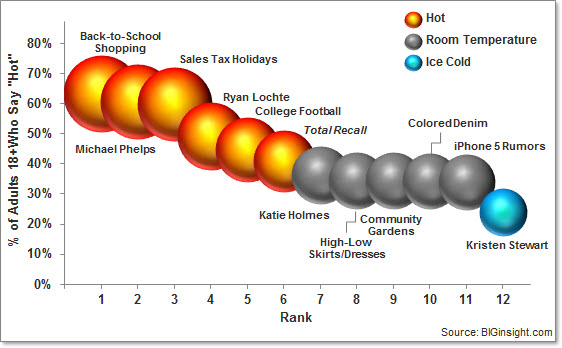
However, the trend line is obvious, as listeners migrate online (from A&O Roadmap 2012):


Pandora, we feel your pain, as more and more folks stream our programming we make less and less money since the numbers generally are too small to increase rates enough to our online advertising efforts to grow revenues sufficiently to cover the costs.


Many A&O clients report now spending the equivalent of two full time salaries on the costs of streaming.  If we're willing to spend that kind of money to do it as a service to listeners who increasingly demand and expect it, we owe it to ourselves to make the quality the best we can make it.

Morris Radio Group Topeka Market Manager Larry Riggins said this week, as he pulled the plug temporarily on ad insertion in the wake of Saga's decision to simply simulcast FM on their streams:  "I just get so frustrated that, as an industry, when something doesn’t work quite the way we need it to, we give up on it instead of investing the time and money in technology to make it work.  Streaming can be a huge boost to radio everywhere if we are willing to use the technology it takes to do it right."


He plans in the long run to hopefully return to ad insertion on his stations' streams.  "We are only going to simulcast until we are comfortable with the performance of the new updates on our current system, or have a new system in place.  We feel our streams are important for listenership and revenue and can enhance what we are doing moving forward."

Meanwhile, of course, there are numerous proven ways other than Ad insertion and/or Ad replacement to enrich the online experience for your listener while still making good online money right now:
  1. Podcasts (audio and video)
  2. Personality blogs
  3. Player takeovers
  4. Synchronized banner ads with audio spots
  5. Social media
  6. Local info and entertainment portals
  7. Mobile apps
  8. Jobs/Help wanted
  9. Portable media
  10. Video pre-rolls 
  11. Discount daily deals
  12. Etc, etc, etc!

Take the time to do some homework yourself by reading and joining in on the many powerful arguments now going on, pro and con
And, if you're lucky, attend the secret meetings.  (smile)

Yes, it would be ideal if radio could offer something much, much better online than what we do on AM and FM.  Yet, as Sean Ross has been pointedly reporting for many years, we simplyhave not been able to accomplish that except in very rare instances.

Country listeners in A&O's 8th annual "Roadmap 2012" perceptual study had some suggestions for you which they said would make them listen longer.

Highlights = far and away the stop 3 answers:
  • Better Quality of sound
  • Faster Connection
  • Eliminate Lag time so I can win contests           

Honorable Mentions for:
  • Fewer commercials, better quality commercials
  • News and traffic updates
  • More Prizes
  • Eliminate the “auto turn off”

So, at present (having been out of the country during the "it was not a secret meeting"), I am also encouraging A&O clients to join Saga in simply simulcasting on air 100% online so the listening experience is at least the same as listeners have come to expect unless you and your ad sales/insertion provider can offer a superior product). 


A second benefit is that the listening recorded by ARB is no longer lost, since it can be claimed as a genuine simulcast. 

Third, with no lengthy delay, listeners can enter and win call in contests in real time and not be faced with the disappointment of learning that they constantly seem to miss the opportunity to win as long as they listen online.

Long term, it seems to me that if you hope to do well in mobile streaming, you're going to have to produce something specifically targeted for the needs of smart phone users, with a much lower commercial load that most of us are carrying on our steams now.

If you're going to dip your toe into streaming audio, make sure it's after putting only your best foot forward!

Saturday, August 25, 2012

Hear Some Terrific Radio

.. commercials, that is. 

Click here to listen to the Radio Mercury Award Finalists

I am thinking that these will be the kind of spots that even the folks who use Apple's new patented ad-skipping pateneted technology someday in the distant future will still stop to listen to!

Friday, August 24, 2012

Why The "Record" Business' Hair Is On Fire

A study from Strategy Analytics reports that downloads and streaming music services such as Pandora and Spotify are set to pass CDs as the music industry’s biggest U.S. revenue source.

SA's Ed Barton posted data on its website predicting U.S. digital music sales will rise to $3.4 billion this year, moving it ahead of the $3.38 billion in revenue from CDs and vinyl.

Within 3 years, digital music will surpass physical purchases globally, he adds.

I can't possibly top the comment in reaction to that news from The Conclave's Tom Kay in this week's Tattler:  "No wonder I’ve had such a devil of a time trying to find that Lady Gaga 8-track."

Wednesday, August 22, 2012

You Never Call

That infamous quote, long attributed to Jewish mothers, is now obsolete for today's Jewish mom of a Millennial, since she's probably a friend on all of her kids' Facebook pages and waits for texts instead of the telephone to ring.

Somehow, though, getting an sms text message on Mother's Day just isn't the same as hearing the voice of that offspring you love.

It's the same with morning radio.

You can't blame listeners for not wanting to call "the request line."

It's busy all the time.
It rings and rings with no answer for many minutes in a row.
If the personality you took the time to phone actually does answer, they sound like they're always in a giant hurry, anxious to simply get you off the phone as quickly as possible.
They can't play that special song for you.
You always end up being "caller number six," wondering what special magic that winning eighth caller had that you didn't.

So, if you lead a typical life and aren't one of the walking wounded who leads such a lonely life that you are willing to put up with those indignities for a few seconds of validation from a radio personality you look up to, you do feel the need to share a story with your favorite radio station, emailing, texting, Tweeting or Facebooking is so much less painless and time-consuming.

Pity the poor radio personality who hopes to hear from "normal" listeners and also knows that reading those written messages aloud on the air isn't as much fun and entertaining as interacting, connecting, engaging, conversing with a real human voice.

What to do?

How about inviting listeners to use the mobile device in their hand to add their two cents to today's hot topic and if it's something you want to use on air, turning the tables and calling them to get audio?

It's not as easy as just picking up the phone in the studio, of course.

Sure, it takes extra effort, time and planning.

Doing the extra little things your competition won't do is what separates "great" from "average."

Tuesday, August 21, 2012

“Where were you when…?”

A recently-released Sony/Nielsen survey asked those-sampled to recall their most memorable TV moment, and if they remembered where-they-were when they watched history happen.

The top 5 moments were:

1. 911
2. Hurricane Katrina
3. O.J. Simpson verdict
4. Space Shuttle Challenger explosion
5. Osama bin Laden death

#42 was the final episode of M*A*S*H.
#43 was The Beatles on The Ed Sullivan Show.
#44 was the “Who Shot J.R.?” episode of Dallas (the-revival-of-which, incidentally, is Summer’s top TV hit).

Drilling-down to demographics:
  • People age 55+ rank President Kennedy’s assassination a close second to 911.  
  • To young people in the sample, President Obama’s election night speech was #3.
  • To women, Princess Diana’s funeral was #4.  To men it was #23.
A reminder to all personalities to constantly update and freshen your demographic target relevant historical references from news talk consultant and friend of A&O Holland Cooke, who reminds me of the great line from the prophetic 2000 book "Millenials Rising:"

"One generation's headline is the next one's punch line."

Monday, August 20, 2012

Radio & Podcast, Mark & Lynda, Brian & Jill, You & The Future?

Kevin Carter and Steve Resnik (click to read Monday's "RAMP" email) wrote a very sensitive recap of what happened Friday on the Los Angeles airwaves (click to listen)

Now, Brian's first post-show podcast with Mark and his new online cohost Jill explains a lot about what's happening to them all next.
"There's more coming, because it's a changing time."

The Wikipedia entry on the longtime duo has now been updated to include the past tense, but provides a great history of their many accomplishments.

Godspeed to both of them as they break new trails for the rest of us who also know that we, too, must  learn to profit from the differences and possibilities of traditional broadcast and emerging interactive media.

Thanks, Mark & Brian, for all you've done to advance the art of radio personality.

Bon voyage on what you plan to do next in new media content creation.

We will all be watching and listening.

Saturday, August 18, 2012

Follow The Leader?

I wish Clear Channel had taken their idea to the NAB with the goal of having all of broadcasting get behind 9/11 Day not just as a feather in the cap of one big company proving how powerful and influential it is but instead making the idea much bigger, big enough for all of us.

BUT, they didn't.  So what now, fellow "frenemies?"  Do we get involved in "their promotion" and get no credit for it in what you know will be the glowing PR to come about how much Clear Channel did for 9/11 Day?
“The overall level of participation surrounding the 10th anniversary of 9/11 was astounding, and we hope to build on last year’s success,” said Jessica King, Director of Community Engagement for Clear Channel. “Clear Channel’s efforts are intended to remind people across the U.S. that they can pay tribute to those impacted by 9/11 by engaging in simple positive acts.” 

There are lots of ways you can commemorate 9/11, named in federal law as a day of service.  Just sign up on the website by registering your project, if getting credit is what drives you and get started.

Other ways to help:
As usual, there is no shortage of ways you can make a difference if you choose to act.

Follow the leader?

Not if the leader is heading toward a cliff, so "study the leader," first. 

But, when the leader is genuinely leading - and a parade is forming - it's time to get in step, join it or organize your own parade going the same way.

Thursday, August 16, 2012

The Experiment

Another in a continuing series of Jay Trachman treasures:

There's nothing wrong with pounding home the "basics": call letters, frequency, your name, the station positioner or slogan. You've got to give people your "address," so they can get back to you. And, the theory goes, if they hear it enough times, just maybe they'll remember when the rating diary falls into their hands.

It may be true, but it's not the whole story.

So let's explore the topic in a little more depth...

Imagine you're at a party where you meet a lot of strangers. If you're like me, you'll forget most of them by tomorrow. Of those you remember, what sticks in your mind? Three principal things: name, appearance and personality.

Who will you remember? The ones who impress you in some way, either positively or negatively. People with whom you've carried on a conversation, found you're on more or less the same wavelength, felt you'd like to know them better. Or, the one who made the biggest fool of him or herself.

Now, try this fantasy: supposing you were introduced to a lot of people, several times. "I'd like you to meet Joe, Mary, Steve, Shirley and Andy.  That's Joe, Mary, Steve, Shirley and Andy. Got that? Joe, Mary, Steve, Shirley and Andy." An hour passes, and none of these people distinguish themselves from the rest of the crowd in any way that matters to you. By now, how many names do you think you'll remember? If you're like me, maybe one. (Usually, the most attractive woman.)

On the other hand, supposing, at this party, you make three new friends, and spend some time chatting with each one. Mentally, you hope to get together with them again after tonight. How many of *them* do you think you'll remember?

See my point? Let's re-cast this as a listener with a dial full of radio stations, punching the "seek/scan" button. And every time they stop at a new station, they hear the call letters, frequency or slogan. How many do you think they'll remember?

But now, our fantasy listener hears something that catches her attention:  her favorite song? Perhaps. Maybe a DJ who's saying something to which she responds emotionally. She likes what she's hearing; she enjoys the brief experience. I submit, this is the one station she will remember, because she is motivated. Motivation is more important than repetition in this process.

Why would a new listener want to remember your station so he or she could find their way back? Because you play the most songs in a row? Because you play the hottest hits? Or the most favorite oldies or the "truest" Country Music?

Don't make me laugh.

When everybody's playing more or less the same music, all in a row, you may think that your slogan or positioning statement is important to your listener, but the evidence is that he or she can't tell your station apart from all the others that are doing essentially the same thing.

Yet that's how 90% of the radio stations attempt to position themselves today. "Most hits, best variety?" If you were a listener with a choice between stations that play 10 in a row, 20 or 30 in a row, would this have meaning to you? What are you offering that he or she can't get anywhere else, and that has meaning to them?

The station must be doing something the listener can perceive as unique, and the DJ has to be talking about things that no one else in town is. Like... his/her own perceptions and responses to life, his experiences as a husband or wife, as a parent, a music lover, a shopper, a jogger, blogger, biker or bowler; above all, as a citizen of this place on this day.

Appeal to me as a fellow human being; that's what I need to motivate me to remember those call letters and that positioning statement.

No matter how many times you say it.

Wednesday, August 15, 2012

Taylor Swift Breaks All The Boundaries

When Time Magazine reports Taylor Swift Has a New Song—Ex-Boyfriends Beware, St. Louis' alternative weekly reports Taylor Swift Just Took Her Pop Queen Throne. All Hail! and the photo of her you get then you simply Google her name is from an Indonesian newspaper site, you know something big is happening.

Jakarta Post


No doubt you've heard that her new single is #1 in one day on iTunes.

Other quick "We Are Never Ever" factoids:

Mediabase reports the song has already been heard by nearly 42 million radio listeners on Country, Top 40, Rhythmic, Hot AC and AC stations.

BDS indicates how deep the penetration has already been in less than two full days across North America:


The average radio station in all these formats has spun it more than five times already.  That average is skewed by the Big Machine-Clear Channel shared revenue relationship, since most Clear Channel stations played it once per hour in the 29 hours from after her Monday night fan Google+/You Tube webinar until late last night.  One Clear Channel country station played it every 20 minutes in multiple hours between midnight and 5 am.

What impact will this have?  Is it possible that "We Are Never Ever Getting Back Together" will debut on next week's spin charts at #1?

Country fans, historically, have reacted negatively to crossover airplay, as both Faith Hill and Shania Twain can attest.  After their amazing success on multiple charts in the late-90's, they never again were as easy an add for country radio as they were before it.

My favorite head-scratcher example of the phenomenon is Dolly Parton.  After "Islands In The Stream" with Kenny Rogers and of course "Nine To Five," she has not had a big hit like her pre-crossover successes and movie stardom.

If the amazingly talented and prolific Dolly's not country enough for our listeners, who could possibly be??

Topping five radio format airplay charts in less than two days is an amazing achievement.  In my lifetime only Elvis was able to do anything even comparable.

Clearly, Taylor is now much bigger than "country," which is terrific for her, because most likely she's going to have a very difficult time when it comes to listener research on her music if history is a reliable guide to the future.

So, Taylor, don't blame country music radio if we're slower to add your music in the future as we work hard to reflect the always-fickle tastes of country listeners.

You're in very good company.

Tuesday, August 14, 2012

Et Tu, Ramsey?

There is a spirited and intelligent debate going on at Mark Ramsey's blog in the comments section in response to his post FM on Mobile Phones? Be Careful what you Wish For.

I don't understand how Mark can cite the fact that Arbitron is still working out the complexities of measuring ear bud listening in PPM measurement as a reason not to have FM on smart phones at all.

Most of the other proponents and opponents can be grouped by their financial interests.  

Count me with Jeff Smulyan and the NAB.  My financial best interest, and perhaps yours will be served by making sure that analog radio's multi-billion dollar business continues for as long as possible, driven by the fact that more than nine of ten people in the U.S. and Canada use it every week, ten times the reach of streaming media.

Sure, let's keep working on digital radio too.  Make the product more listenable and unique.  Find a way to improve the financial model so that it's possible to make a comparable profit to FM and AM radio today while continuing to serve local communities with quality content.

On the other side:  CEA and CTIA.  If listeners can't get "free radio" anymore on FM/AM in their vehicles and mobile devices, they make more money since we'll be paying them for the bandwidth that analog radio makes so ubiquitous.  No wonder that they don't want us on their platforms.

Where Ramsey's opposition is coming from is less clear to me.  I assume it's idealism and a drive to push us all as rapidly as possible into the future, since his financial interests are supported by today's radio too.

Of course, the future is definitely coming at us lickedy split and we are in the midst of rebuilding business models to capitalize on it, but that's no reason to shut the doors and turn out the lights while radio just as it is today remains so important to so many folks (FM Chips in Cell Phones Survey Results - NAB).

I think Voltaire was right, Mark Ramsey.

Sunday, August 12, 2012

Back To School Is Big

The August report from Big Research:


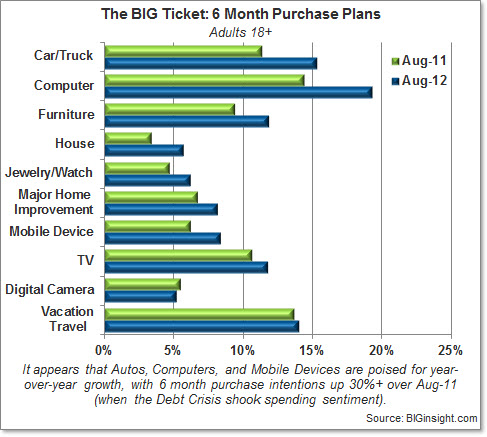
With school nearly in session, popular categories like Children’s Clothing, Shoes, Health & Beauty Aids, and Electronics are looking UPward over the next 90 days, according to the BIGinsight™ Diffusion Index. In addition, all other categories – save for seasonal Lawn & Garden – are poised for spending increases compared to last month, last year.


It appears that shoppers are maintaining a more optimistic stance this year when it comes to big ticket purchasing over the next six months (which, of course, includes the upcoming holiday season)…compared to Aug-11, purchase intentions are on the rise for computers, autos, housing, furniture, jewelry, mobile devices, major home improvements, and TVs, while digital cameras and vacation travel are relatively flat:


If you can't figure out why I think you'll be interested in these stats, we need to talk! 

Friday, August 10, 2012

You Go, Beau!

In the early 80's, I was PD at KMPS/Seattle and he was GM for what even way back then was clearly "Seattle's Best Rock," KISW.  The instant I heard his radio station I knew that this guy Beau Phillips was someone special and as I got to know his people my admiration grew.  He inspired them.  He challenged them.  He and his team created great radio.

Not surprisingly, Beau has been involved with some of the most impressive media launches and campaigns over the three decades since that time.

His Dial Global Networks exit interview with Radio Ink Magazine contains wisdom which will sustain his many industry fans (of which I am a big one) for a long time to come:
- Build a lasting brand. Radio jukeboxes can’t compete against stations who create an emotional bond with listeners. Engage listeners and create loyalty through clever personalities, topical and timely info, and music discovery.
- Stop trying to outsmart PPM.
- Invest in personalities. They are our biggest competitive advantage. Not one station in the Top 50 markets wins with “more music” in AM Drive.
- Focus on adding great content. Too much attention is being paid to eliminating anything that listeners might tune OUT. But not enough effort is made to add exciting content to encourage tune IN. The game is all about creating more listening “instances."
- Realize that you can’t "cut to success." Now that broadcasters are running lean operations, it’s time for Act II -- Growing The Stations. Look to brilliant stations like WTOP, KISW, and WBEB as your beacon. Successful companies know the winning formula is People, Product, Promotion, Profit…in that order. The shrink and starve approach just can’t sustain. You can’t, and will drive yourself crazy trying.

Take and live by this advice, radio, and your future will be very bright.  His own life example offers ample proof of that.

Thank you, Beau.  Best wishes on your next conquest!

We'll all be watching you very closely to see what inspires you and where you'll devote your endless energy and creativity next.


Thursday, August 09, 2012

Commercial Radio News' "Slow Walk" Compared To Competing Media

Lawrence Stessin Distinguished Professor of Journalism and chair of the Department of Journalism, Media Studies, and Public Relations at Hofstra University, Bob Papper's annual TV and Radio News Staffing and Profitability Survey for 2012 reports that radio continues to make strides in the use of social media (click to download his pdf report), but we remain well behind television.

Papper:  "A year ago, radio soared in the use of social media; this time around growth was more like a slow walk.  All the categories rose, but, overall, the gains were mostly from stations already engaged in some social media doing more."
Overall, the use of Facebook in radio news rose another 10% in the last year (following last year's 10% increase).  Large and major market stations were much more likely to have Facebook pages than stations in small and medium markets.  Non-commercial stations led commercial ones.

Similarly, use of Twitter rose 9% from a year ago (which was up 12% from the year before).  But all of that increase came among "periodic" users of Twitter.  Both "constant" and "daily" use remained essentially unchanged.

Thanks, Bob.  We need your annual "wake up call."

Wednesday, August 08, 2012

Things That No Longer Work

Thanks to Don Anthony for another terrific issue of "Mouth" and to "iconic Minneapolis radio deity," Dave Ryan of Clear Channel's KDWB, who weighs in on things that may no longer work on the radio. Can you add to his list?

"A couple months ago, I wrote an article for this fine publication about the things in radio that just don't really ever change. We talked about how there's at least one male whore on every air staff. (Usually the night guy) I mentioned how engineers tend to be some of the oddest people in the building. And how there's one person on every staff that you aren't quite sure exactly what they do. These are constants in the radio business." 

Later, at the urging of a friend, Ryan decided to make a list of what he thought no longer works on the radio:
  • "Stunt boys: Years ago, everyone had a "Goat Boy" who went out and got attacked by a police dog or went cliff-diving ... all for giggles. We don't do that anymore, because I really think it belongs to another era of radio. Today, listeners want to hear the star of the show ride a bull, get hit by a stun gun or have a finger cut off. Even the idea of saying, "Here's Xtreme Jamie out on the street, ready to get dragged behind a car" makes me cringe a little. It was incredibly fun radio back then, but just like Tom Green, it's time has passed."
  • "Endless Entertainment reports: Yes, we still do entertainment news every day. But we don't talk about everything under the sun ...We don't spend a lot of time on the Kardashians. Why? Two reasons: One, everyone else in the market is talking about that stuff. Someone once told me, "If all the restaurants on your street are selling steak, sell chicken." Offer your audience something different. "But Dave," you cry, "Our consultant tells us we have to talk endlessly about 'Biggest Loser.'" I know that. Cover it occasionally. But here's a question: "America's Got Talent" is a huge show. Tell me how much time they spend every week discussing the Kardashians or 'American Idol'? Of course it's none. Zero. Zip. The show is interesting on it's own. But take the argument some consultants make and apply it to "America's Got Talent" and by his estimation, it should be getting slaughtered in the ratings for not doing entertainment reports. Speaking of which, my second point is, make your show interesting enough with characters, plots, storylines and storytelling, that you don't need to rely on Hollywood gossip to fill up your four hours."
  • Double time checks: I put this in almost as a joke. Years ago, a consultant listened to our show and his only feedback? Do double time checks. Yep. "It's seven Oh five, five minutes past seven." Today, I'm not even sure time checks are necessary. Everyone has a cell phone in their hand or in their pocket. Turn it on and BOOM, there's the time. I still do them, probably more out of habit than anything else, but I'm not sure we need them. Same with weather forecasts. They can't hurt really, but it's there on everyone's cell phone.
  • Music beds: I think this is one of those things radio came up with 20 years ago and never really explained why they needed to exist. I used to have a zillion carts (remember them?) with music beds on a big giant rotating rack. Talk to callers? Use a music bed. Put a winner on the air? Use another one. Be very quiet and listen right now. Is there a music bed playing in the background of your life? When Oprah talked to Paris Jackson, was there a cool hip-hop instrumental in the background? Randy Lane told me one of the most compelling sounds on the radio can be that second or two of silence while someone is thinking and we're all wondering what they're going to say. A music bed can only take away from that.
Tomorrow, in Pt. 4, he addresses 'Characters and Being Cool.'

Monday, August 06, 2012

The "D" In HD Radio = "Darn?"

I have an Accurian HD Radio on my bedside table and have been carefully setting aside an hour with a cup of coffee for the past five weeks to listen closely to the replay of Robert Harris' fascinating five hour long "History Of The Gods" on CBC's Sunday Edition with Michael Enright

"The traditional record business is dying. What will happen when it goes?" 

By and large, I enjoy the additional choices the radio gives.  It brings me every Seattle FM station's programming times three and fairly-impressive sound.

The always-thought-provoking CBC program is broadcast on KOUW-FM HD2, with KUOW's main channel on HD1 and the BBC World Service 24/7 on HD3

Sure, I could have listened to it on CBC's web site, but the convenience of having that radio in my bedroom has been a terrific reminder for me that HD Radio could indeed be a part of radio's future, in spite of the fact that a tiny percentage of today's radio audience uses it in the wake of considerable promotion and increasing availability, due to the turnaround in American auto sales.

Suddenly, I feel a bit like Don Quixote.  After investing five hours of my time listening (building up to the show's climax in the last two minutes when it seemed like host Enright was about to tell me what was going to happen to the music business), suddenly the audio dropped completely.

I switched to HD1 and of course the normal KUOW analog FM programming was loud and clear.  HD3 was also coming in just fine, but HD2 was silent.  No signal. 

My Bainbridge Island bedroom is 14 miles from KUOW's 100,000 transmitter and tower atop Seattle's Capitol Hill.

Lesson learned.

I can't count on HD Radio when I really need it.

Up to now, I had always considered myself ahead of the curve technically as one of the only people on my block with an HD Radio, thinking that eventually everyone else would some day catch up with me.

Today, as I had to head to the Internet in order to reliably hear those terrific final minutes of the program on demand via my smart phone, I realized that my HD Radio-less friends had beaten me to the media future, while I - like the recording industry - was the one trying hopelessly to hold onto a past that's quickly vanishing.

My $200 "digital" bedside radio let me down and my smart phone which costs exactly the same amount rescued me.

It does everything my radio does (yes, it does have FM radio on it) and many things more as well.

What took me so long to figure that out?

Saturday, August 04, 2012

I Know How Local NPR, Glenn Beck, ESPN and Rush Affiliates Feel

While it's terrific to see a nationally-syndicated host active on the net, pulling his fans into his video content, I wish there was a way to do it through local affiliate websites and make sure that these network shows aren't replacing the relationship that still provides the bulk of their paychecks and gives them the reach with a direct connection to their listeners which replaces a consistent source of monitization with an unknown and less certain one.

If a national personality's online initiatives ultimately make their listeners stop using "radio" to hear, see, converse with them, what business are they in?

Thursday, August 02, 2012

It's Bad Enough That They Had A Fire

BBM Canada distributed a notice today, reporting on the PPM monthly data for Corus' CHQR/CFGQ-FM/CKRY-FM, Calgary, titled "Encoding Issue:"
As a result of a fire at the station, the signals for CHQR, CFGQ-FM and CKRY-FM were unencoded on July 11, 2012 for a period of approximately 28 hours.  The approximate start and end times of the incident are detailed in the PPM Technical Incident Report which is available on BBM’s secure website.

It's one thing to report the news.  It's quite another to BE the news.

Fortunately, the week 40-52 BBM survey is 13 weeks long, running from May 28 through August 26, releasing on September 6.

You have to know that today's Calgary monthly PPM release had to make some local Corus people's hair catch on fire and anyone who's measured by PPM these days had to feel some sympathy pains.

Let's hope that the final quarterly update gets back to normal for 'em.

Meanwhile, make a note:  in addition to a generator, plus all of the standby transmission and audio chain equipment it takes to have as a backup to be ready for anything, don't forget that backup encoder too (or when you go off your main audio chain, move your encoder as fast as possible to the redundant system).

At a time when more folks are turning to you for information, don't neglect to work as well to have that usage accurately measured.

Wednesday, August 01, 2012

Have A Nice Piece Of Pie!

Coady Diemar's Chris Ensley Terrestrial radio’s reach has remained relatively flat over the years. For example, in 2001 radio reached 95% of the U.S. 12+ population, and today it reaches 93%. However, over the same time frame the U.S. population has grown, and as a result, so too has radio’s weekly reach, as we show in the chart below. Arbitron recently estimated that radio reaches 241 million Americans over the age of 12 each week, and based on our estimates, we believe that reflects approximately 16 million incremental listeners relative to 2001, when we estimate the industry reached 225 million weekly listeners. 

TV viewing trends (the broadcast networks) typically experienced ratings declines in the mid-to high single digit range, but had made up for that through pricing increases. In the chart below, we look at time spent listening to terrestrial radio and note that in the first half of the last decade, time spent listening declines were very modest, roughly 1.2%-1.3% per year.


Tuesday, July 31, 2012

A Tale Of Two Non-Hits

It boggles my mind to think how much this guy's backers have spent on airplane tickets, as he has conducted his "Hometown Radio Handshake Tour" in recent months.


What did he get for all that effort and money?

The song is not listed anywhere on either the Billboard Country Hot 60 or Country Aircheck chart this morning.  In fact, during the last seven days, one station played his song 11 times, two played it 8-9 times and six spun it 1 or 2 times.

What to make of that?

It takes more than money and lots of face-to-face contact with local programmers to get yourself a hit.

Frankly, that restores my faith a bit in what we do and how it all works.

Then, there's Callout America's #5 testing song today, Phil Vassar's "Don't Miss Your Life."


This one has to be very perplexing to Vassar and his promotion team, since it moves down from 34 to 35 on the Country Aircheck chart with no bullet and is nowhere to be seen now on Billboard's Hot 60, having moved backward sufficient weeks to be dropped.

Meanwhile, one-third of the monitored panels seems to be ignoring the chart malaise and playing it very heavily.  Four stations played it more than 35 times in the last week.  18 spun it 20 times or more in the last seven days and 19 more still have it in a ten+ spin category.

Obviously, in spite of the national inactivity, it has been working for at least a few stations.

Hats off to these smart programmers who went with their local listener reaction to what has proven to be a good national tester.

It's sad to see so many chart reporters going with the herd, feeding back to the charts what the charts are telling them are the hits.

Small wonder new things things move so slowly in the country format right now.

Sunday, July 29, 2012

Magic Moments

Loyalty and engagement with all media are built on powerful positive "magic moments."

That time LinkedIn let you know that a longtime friend just received a big promotion.

When Facebook put you together with a high school buddy you haven't heard from in years.

The instant when Twitter let you know the results of your favorite Olympic sport many hours before the event was replayed on NBC-TV.

The more frequently these kind of moments happen, the closer you feel to the medium, the brand, the personality and the more you "use" them regularly.

Then, there are those other moments.  When you get a LinkinIn email saying a business associate wants to connect with you, but when you click on the link it says that the notice was sent to the wrong email address.  When Facebook keeps wanting to reinstall the Android app you just UNinstalled because it eats up too much memory and is too slow when compared to just using your browser to get onto Facebook.  When NBC-TV edited out the very part of the opening ceremonies you wanted to see the most.

Trust gets betrayed.  Usage decreases.  Brand gets tarnished.

What happens when you ask for "caller #9" and you recognize the voice of the regular winner who always seems to get through and win when you have the best prizes up for grabs?  When hundreds of other people get only a busy signal and mutter under their breath that radio contests are all fixed?

When your info update consists of "the news is coming up on the hour" and the listener looks at their smart phone and realizes that their personal information aggregation app has ALL the news for the refreshing at any instant they want it and that they never have to wait for "the news?"

When a radio station keeps pushing "the most music" and automated song-sweeper-song-jingle-song-sweeper hours when listeners voted in at least four different research projects released since the first of the year, including A&O's Roadmap 2012 perceptual study, for "fun personalities who feel like friends and make me feel better when I listen?"

It's easy to do things the way you've always done them and ignore listener needs. 

There's some "magic" in that too.

It will make your audience disappear.

Wednesday, July 25, 2012

Should You Use This Prep?

From...

NEIL HAISLOP's NASHVILLE IQ © July 25, 2012:
TODAY SHOW TAPS CARRIE UNDERWOOD FOR SUMMER CONCERTS
Carrie Underwood will perform on the Today Show Summer Concert Series this August as the morning show plans a full week of outdoor concerts following the 2012 Summer Olympics. Carrie's concert in Rockefeller Plaza is set for Wednesday, August 15.

Among her hits, Carrie's set will also include the title track and new single "Blown Away" from her fourth album. "Blown Away," the single, has sales approaching quarter of a million and was written by Josh Kear and Chris Tompkins who also co-penned her smash hit, "Before He Cheats."

They've got us, don't they?  Damned if we do, and damned if we don't.

There are at least four or five terrific morning shows competing with radio very aggressively and creatively in your local market, of course, (and they really cut into our "at home" usage because they do big things radio is very often not doing).

It's not smart to ignore it when our biggest stars show up on competing channels, and yet it's equally dumb to promote turning them on at the same time, thus reminding your listener that there's something better they can enjoy right now.

I don't blame the music community for making the most of every promotional opportunity open to them.

We need to go where the audience is and ignoring anything they care about would be fatal.

What are you doing tomorrow morning to TOP all of the competition for their time and attention?

Tuesday, July 24, 2012

Tough Competition Takes The Gloves Off. So Should Radio.

The wireless industry's trade group just posted videos on You Tube of their "reporter" across the street from the NAB offices in Washington, D.C., to purport that only 20% of people they asked said they want FM in their cell phone.

Actually, given that almost no one has promoted the fact that FM is available on cell phones to consumers, I thought 20% was a pretty good starting point compared to all the other "apps" smartphone consumers have to learn about and a reminder to us in radio that we can't assume that others don't have long term profit motives at our expense driving their position to exclude "radio" from wireless devices of all kinds, depriving our listeners of service they count and depend on.

Now, there's talk of closed door meetings at the FCC on the issue.

I'll leave the "public safety" argument to NAB and hope that they're telling our story as effectively as possible, but the current issue of United Airlines' inflight magazine features an article introducing "Shannon’s Law" as an additional point to ponder.
Claude Shannon was an MIT researcher who, in 1948, came up with an equation that explained how two factors limit the amount of information that can be accurately transmitted over any communication channel: the bandwidth available and the noise present that could disturb the signal. Using those two numbers, you can figure out the maximum amount of information that a particular link can handle.

I won’t bore you with the math. But the upshot is that we’re coming very, very close to reaching the bandwidth limits determined by Shannon’s Law. Soon, the typical cell tower simply won’t be able to handle any more data. Which means we’re going to need to come up with a solution if we want everyone to be able to watch the latest episode of “Game of Thrones” on their iPhone.

Tech writer Mark McClusky:  "Bandwidth, as it turns out, is subject to not just the laws of physics, but also the laws of supply and demand. Both point to one unpleasant realization: The true cost of wireless data access has been hidden from us for quite a while, and it’s time to pay the piper."

Of course, the wireless industry can't wait until we all have no other option in our mobile devices so that they can increase the cost of that bandwidth.

But, meanwhile, it's my humble opinion that it's in the consumers' best interest to have "free radio" as an option for information and entertainment that they don't have to pay for to make use of and enjoy.

If you agree, start working to move that "20%" number UP by letting listeners know that something they now take for granted, perhaps use unconsciously, needs to be on their future wireless devices and dashboards .. for their own good.

Sunday, July 22, 2012

I Thought We Seattleites Were Smarter

Lumosity data scientist Daniel Sternberg, PhD looked only at the very first Brain Performance Index Lumosity members receive after playing at least one game in each of the five brain areas—this eliminated any practice effects, controlled for age and gender, thus removing as many confounding variables as possible.

He then converted BPI into a normalized IQ-like scale, in which 100 points represents an average "BPI" score out of all the site's US users. Scoring users based on other users—in other words, by percentile—allowed him to directly compare and combine the five brain area scores into a composite measure of overall performance.

We then tagged these normalized BPI scores to US metro areas, culling out those areas with fewer than 500 BPI scores (to ensure meaningful results) he has located what he thinks may be the smartest cities in America—and we’ve done so by measuring the cognition of the people who live there.  (click to read all about it, including his rankings of 188 cities)

Ranking #1: Charlottesville VA.  If you live in Albany GA., you may not want to tell your friends about this blog post.

Lumosity’s "smartest cities" ranking was picked up by many publications and news channels, including the Atlantic (which you can read here), so keeping your town's rank hush-hust may not be that easy.

It must have been a slow news day.

I do take heart in his statement and I'm working to bring Seattle's scores up:  "...if there’s one thing we’ve learned about cognitive performance, it’s this: no matter where your city is on our list, you have personal control over your brain’s abilities."

Thursday, July 19, 2012

What's Your "Sound?"

The Katz press release, released yesterday, is a timely reminder:

Who could mistake the distinctive sound of the "Dum-dum" from Law and Order? Or the famous "Aflac quack" from the duck in the TV ads? New research from Katz Marketing Solutions, the national marketing arm of the Katz Media Group has confirmed that "sonic branding" is definitely a powerful force advertisers should take advantage of. Today Katz released a new study of advertisers' sonic brands and their impact on communicating brand messaging and eliciting emotional responses.

"The results confirm the incredible power of sound," said Bob McCurdy, President of Katz Marketing Solutions. "With this research, we have a better understanding of how sound impacts what we see, how we feel and what we consume. Even a brief one or two seconds of sound can trigger powerful brand messaging and explicit visual images, which means radio can be an extremely influential tool for advertisers."

While previous studies have focused on brand identification, Katz Marketing Solutions commissioned this research to delve beyond awareness metrics. Instead, the study quantified the communication and emotional impact of sonic brands of the top U.S. advertisers including McDonald's, Mazda, Old Spice and Pillsbury, among 20 others. The intended goal was to measure both the ability of these sound bites to communicate a brand message and to generate emotions.


Click around the study's website for lots of sales ammo, but it's more than that as well.

What music are you using behind that commercial?

What message does the sound of your station voice send?

Do you have your own equivalent of NBC's chimes?

Have you tested it with your listeners to be certain it sends the image you intend?

I'll play you ours (click to listen), if you'll play me yours too.

Let's work together to attain mnemonic audio perfection for both ourselves and advertisers who use our air.

Wednesday, July 18, 2012

Sometimes 1 + 1 = 3

Cumulus General Managers reportedly build a monthly report for corporate which shows each sales rep's percentage of the month's revenue and also their percentage of total available inventory used to get there.

I love this correlation, since it could help a strong sales manager stop a problem in advance.  Is your top biller taking up so much inventory to get to their goal that they are sucking the air out of the room for all the other sales people?

Other measures it would be nice to track as well:
  • For the program director.  Is there any correlation between the number of air check sessions you do with your air personalities and their ratings?  If, the more you meet with them, the lower they go, something's seriously wrong.
  • For the music director.  What percentage of "stiffs" vs "hits" did you add?  How many songs do you end up dropping each month vs the number which end up testing very well with your listeners?
  • For the air personality.  Is there a relationship between the length of time you open the microphone and audience loss/retention data?  (PPM has made tracking this quite possible)
What other things which you routinely do might you be able to correlate with the results they achieve? 

“You can’t control what you can’t measure” - Tom De Marco

Monday, July 16, 2012

Hey, News Writers: Make The Turn

Recently at a client station cluster where a TV station news staff is tasked with writing news for all radio, online and video news, I was asked to talk to a terrific co-host of the top 40 morning team.

Part of her gig is reading a quick update every half hour and everyone (including her!) is concerned about reading errors being made in these segments of the show where she's executing every other aspect of her role almost perfectly.

The PD confessed that he knows next to nothing about news writing or reporting and feels like he doesn't know what to tell her, given that all other aspects of work work are exemplary, including the ratings of the morning show.

I asked her to play me a sample air check of a typical 'cast where she wished she had done a better job of reading.

She knew exactly what to play for me:  "the 44-year old man was killed in the accident, police say, because he had difficulty negotiating the turn.."

What caused her reading of that story to be less than natural and conversational, she said, was because she got to thinking in mid-sentence that perhaps a better word than "negotiating" and wondered if "navigating" was the correct word.

Of course, I told her that if she wanted to think about things like that it needed to be done when she pre-read the stories in advance and encouraged her to prep better so that things didn't catch her by surprise.

Ultimately, just between us, I actually blame the person who wrote the story even more.
  • "44-year old" is newspaper style writing.  Archaic. Does giving the age increase or decrease the power of the lead?
  • "Police say" isn't really needed is it?  The guy is dead.  If there's any doubt, of course, attribute it, but if not, why use the old wire service style of writing when you know someone really was prounced dead and relatives have been notified.  
  • "Negotiating/navigating?"  Rather than trying to show off your fancy reading vocabulary, how about simply writing to be "heard" and "read."
Better, shorter, crisper (and easier to read):  "Man dies when he failed to make the turn."

A note to news writers and all of the people who have to read their output:  if the youngest person on your staff - who happens to be right in the center of the target of your radio station - can't easily read and understand every story, how do you expect listeners to?

Make the turn.

Simplify your news writing.  Lower the grade level of what you write.  Simple sentences.  Short phrases, like telegrams.  Powerful, active verbs.

It's not about dumbing down your news.  It's about making it appeal to a larger audience.

Wednesday, July 11, 2012

Headlines, Teases, Pictures

Slate's points out that BuzzFeed has made a very successful business out of taking Reddit items adding a compelling headline and teaser which draws an audience many times the size of the original source.
For example, I could insert a photo of Slate's technology columnist here OR, alternatively, go with the photo Farhad used along with the headline used for his article, which - like Buzzfeed - he borrowed from the original article (21 Pictures That Will Restore Your Faith in Humanity”).
Which are you going to click on?

This is as much about today's culture and audience expectations as it is about the Internet or aggregation of content.

Don't start to tell a story or share a video on air, your blog, your podcast, your website until you have a great headline and lead sentence for it.

Be like Buzzfeed, Huffington Post and Drudge Report, not Les Nessman.

Tuesday, July 10, 2012

Philosophy

The first time I saw a resume from a programming applicant which also contained a multi-page statement of the person's philosophy of programming, I was so impressed.

Now, 15-million of them later, I have learned a valuable lesson:  the strongest philosophy (or strategy) doesn't achieve anything unless it's audible on the radio every time listeners tune in.

These days, I am less impressed by lengthy statements of general and fundamental problems.  Now, I want to know what you do to bring it all to life in entertaining, engaging, compelling ways.

How's your execution of that philosophy in reality?

How about laying that out in detail, with proof?

Stand out from the pack.

Sunday, July 08, 2012

Heuristics

 Jeff Wise, writing in Psychology Today
The hiker who leaves a well-marked trail and wanders off, cross-country. The pilot who flies his perfectly maintained airplane into the ground. The kayaker who dives into a hydraulic whitewater "grinder" even though he's just seen it suck three buddies to their doom. "Gee," you think when you hear such tales, "I'd never do something like that." But would you? We like to think of ourselves as pretty rational, but that's hardly how we seem from the perspective of accident investigators and search-and-rescue crews.

Heuristic methods
are used to speed up the process of finding a satisfactory solution. Examples of this method include using a rule of thumb, an educated guess, an intuitive judgment, or common sense.

The trouble is, as Wise states in "Deadly Mind Traps," People who deal with the aftermath of human error can tell you all too well that otherwise normal, healthy individuals are exceptionally predisposed to making the kind of mistake best described as boneheaded because we were on autopilot, relying on habit and time-saving rules of thumb.

Best-selling author Dan Pink has one of the top 20 most-viewed TED.com talks on "the surprising science of motivation" which makes a convincing case that traditional methods of motivating employees not only do not work, but they actually can be counter-productive.

I've long felt that way about ratings bonuses for personalities and programmers, thinking that it would be better to pay the bonus when the individual does the things that will be most likely to make the ratings go up, quite specifically, rather than crossing your fingers and hoping the sample is good and ratings reflect the outcome of the work, creating the attitude "it sometimes works and sometimes doesn't" in your key people and making the motivation based more on good luck than good work.

It's been my pragmatic belief as a manager that it's actually impossible for anyone to motivate anyone else.  So, my approach has been to try to create the conditions to recognize and reward self-motivation.

Then, I stumbled on this research from Ohio State researcher Steven Reiss who postulates “There is no real evidence that intrinsic motivation even exists.”  The argument is that people should do something because they enjoy it, and that rewards only sabotage natural desire.  Reiss disagrees.
“There is no reason that money can't be an effective motivator, or that grades can't motivate students in school,” he said. “It's all a matter of individual differences. Different people are motivated in different ways."

No wonder, given when we know about heuristics.  Putting yourself on auto-pilot, while believing you're cruising toward the goal can easily end in disaster.

Like that great philosopher and psychologist Garth Brooks has said:  “The greatest conflicts are not between two people but between one person and himself.”

When you recognize yourself starting to glide into one of the "I've always done it that way" mind traps on the way to an important goal, stop, take a breath, and turn on your rational brain.

Saturday, July 07, 2012

Rick Dees

The news last week that Dees is out, and Jimmy Reyes gets the wake-up call starting 6-9 a.m. Monday on Hot 92.3 FM (KHHT) has a few lessons imbedded in it.
Dees quickly e-mailed Orange Country Register media columnist Gary Lycan"We launched a one-year marketing campaign with my friends at Clear Channel to increase the awareness and revenue of Hot 92.3. The campaign has been a great success and we look forward to other new shows and marketing strategies with the talented team from Clear Channel in the near future. See you on the air again soon and at www.rick.com plus all over the world with the Rick Dees Weekly Top 40 and Daily DeesRadio Show. Be caller #10."

A&O has been fortunate to work with Rick's production company and I can personally testify that his positive attitude isn't just "spin."

He's the real deal.  An entrepreneur who gives 100% to everything he undertakes.

Greg Ashlock, president and market manager of the Clear Channel stations in Los Angeles, wrote in a memo to his staff also quoted by Lycan last week, "Rick has been with us for a year and we've thoroughly enjoyed every moment. He's a consummate professional and we wish him the best as he pursues some national opportunities."

Before I say much more, let's put my personal biases on the table.

I know what Ashlock says about Rick is true,

Hindsight is 20/20, but I have always felt that if Emmis had put Rick in mornings on KZLA and kept it country back in 2006 when they hired him to relaunch the station at "Movin' 93.9" it would have been a match made in heaven and country radio in Los Angeles would be billing considerably more than what Go Country 105 has been doing very happily since they filled the void, due to Dees' power with listeners and savvy with advertisers.

I am a big Dees fan (click to listen to three consummate pros in action earlier this year on Ellen K's birthday on KISS-FM as an example of why I am).

I admire his ability to bring his entire self and skill set to every opportunity as well as his business acumen, professionalism and optimism in dealing with career adversity.

He's an inspiration to anyone who's serious about building a long-lasting career in this business.

Lesson #1:  when the station you're on is positioned as both "hot" and "old school," make sure your fan base really wants you to be "old school" too and if it's possible to be both things the position statement promises.

Lesson #2:  when, like happened with "Movin'", people describe the place where you work as "the Rick Dees Station," it could be a sign that the station's music format may not be the best one to attach yourself to unless you're prepared to work 24/7.

Lesson #3:  when the axe falls, be proactive and positive.  You want to work for these people again in the future.

Lesson #4:  keep a lot of other irons in the fire.


If you're ever in Burbank, stop by his studios just off the Ventura Freeway near Riverside and Olive and see everything he's up to.

And, if you're ever in need of a place to broadcast live from beautiful downtown Burbank for a special event, I know he'd be pleased to do business with you.

That's Rick.  Moving forward, never looking backward.

Tuesday, July 03, 2012

Ann Curry

Was it that Matt Lauer just didn't like her?
 

Could viewers tell that she didn't like doing the mandatory pop culture and food segments, preferring to do more hard news, which hurt ratings?

Fortunately, in spite of the public humiliation of the past weeks' events, she has a long term seven year contract, so NBC is going to have to find a more suitable position for her desires and talents.

Ann won't be joining the ranks of the unemployed, as probably would have happened if a similar thing happened at your radio station making the negative fallout from a poor choice in matching talent with an opportunity greater..

Anyone who has had to make tough personnel decisions or who has been the victim of them simply has to feel for both Ann and NBC News chief Steve Capus, who decided to pull the plug on her last week.

The trouble with change in radio and television is that the first folks who learn about it are the people who like and enjoy the personality, since people who had been turned off by poor personal chemistry, content that didn't relate to them or the fact that they just didn't connect .. and most likely they were no longer viewing or listening.

So, even if a terrific new person is brought in to "fix" the problem, the numbers will still most likely go down, taking a long time to rebuild.

Curry told USA Today's Susan Page that her new job as one that any journalist would crave, she makes no secret that the very public process that pushed her out of the co-host chair amid rumor-fed headlines has left wounds.

"I don't know who has been behind the leaks, but no question they've hurt deeply," she says. She admits she would have liked more time to work things out as co-host, and she bristles a bit at the suggestion that she lacked "chemistry" with co-host Matt Lauer.

"You know, Matt and I have had great on-air chemistry for 14 years, been part of the No. 1 winning team for a history-making number of years," she says. "That said, I just finished my freshman year as co-host. In every single co-host's first year, there have been kinks to be worked out, and perhaps I deserve as much blame for that as anyone."

Does she think she was given enough time to work out those kinks? "No, I do not," she says flatly.

Would she have liked more time? "Oh, sure I would have," she says.


NBC News chief Steve Capus candidly told The Hollywood Report that he thought Curry had not been right for the job in many respects. He said he agreed with interviewer Marisa Guthrie that Curry had faltered in the cooking segments, movie star interviews and fluffy features that make up a large portion of "Today."

"I think her real passion is built around reporting on international stories," he said. "It’s tough to convey a sincere interest in something if you don’t possess it ... and you could tell with her, you can tell with any anchor, whether they’re into it or not. And I think we’ve now come up with a role that will play to her strengths.”

Capus said that, although he felt it was right to give Curry a chance at the top "Today" job (she had put in fourteen years as newsreader and already been passed over once before), he had had no choice but to make the change.

“We gave her a year to prove herself, and ultimately we came to the conclusion that she had played at the highest level she could," he said. "When you’re in the major leagues of our profession, you’ve got to continue to be at peak performance in order to stay there."


A good reminder when you are interviewing talent for any opening.

Take time to really get to know the candidate.  Be sure that the people he/she will be working with have what it takes to build positive chemistry.  Check references.  Double check everything.  Don't make snap decisions.

And, still, realize that it might not "click" right at the start.

Knowing how long to give something that isn't working is as much an art as the original hiring process.