Wednesday, February 22, 2012

80/20

Edison Research's Larry Rosin does it again. It seems like roughly every few years he has a way of visiting the Country Radio Seminar with data which changes everything. Will today's revelations do it again?
Beyond Country's P1s - Edison Research Presentation for CRS 2012
Only yesterday, A&O's Country Roadmap 2012 - a survey of country radio station social network and email database members reported on the other side of the coin, folks who on average listen to country radio two hours a day and are extremely satisfied with their favorite country station, though also complain about too much repetition and commercials in very high numbers.

Which study is correct?

Both.

No one said your job was going to be easy when you got into country music radio.

Which is more productive for you?

Focusing on the core? Leaning toward the interested, but unengaged outsiders?

Getting that balance right is what will separate winners from losers in 2012.

Monday, February 20, 2012

Politics

Every decade or so, as generations shift, new programmers come to country radio from contemporary formats.

That's how I got into country four decades ago, and I'd bet it's how you came to the format as well.

And, as usual, country has a way of growing on the newcomers, ingraining itself into their sensibilities just as they help to add contemporary flair, ideas, approaches and style to keep country growing with the young end of our target.

Recently I was surprised to hear one of the former-CHR programmers who is now doing country say that he now feels that the process of music decision-making is the "most political" of all radio formats.

If true, that's too bad, because until the early-1990's when the country boom took country music revenues to heights never seen previously and then after consolidation Jacor's Randy Michaels tried to work through Tri-State Promotions as they acquired more and more stations, opening the door for Jeff McCluskey, who in 1999 paid Cumulus a reported $1 million to influence the growing groups' music programmers, independent promotion in country music radio meant folks who only attempted to build relationships with music directors and sell music to them with creative ideas and seldom any financial incentives.

If things are more political now, I'd call Clear Channel's Doug Montgomery and Clay Hunnicutt the "Mitt Romney" of our business with their position of incumbency grown over the past two decades since those initiatives, which brought other aggressive promotional indies from contemporary and rock formats to country radio and Cumulus' Jan Jeffries and Mike McVay the Rick Santorum of the competition between radio's largest conglomerates as they strive to trim playlists, pay down debt and yet send a message to the music community that they remain open to doing business with them.

CBS' Jeff Garrison may be the Barack Obama of the threesome, working to grow artist relations for the company (which once owned 18 country stations in the top 20 markets and had higher cume for their country stations than anyone before they sold off a few of them several years ago, hoping the economy treats them better in '12 than it has in '10 and '11) has to be feeling the pressure of those other two breathing down his neck in the race for promotions ownership, as Nashville labels, managers, indies and publishers start to feel increasingly like influential think tanks, lobbysts and SuperPACs as they attempt to mold coalitions with everyone, trying to seem friendly with all, even as their revenues slide precipitously.

For them, the stakes are even higher than ever, since listener research continues to show, for example in A&O's 2012 Roadmap country perceptual study, despite attempts at new media marketing direct to music consumers, that terrestrial radio exposure remains the most effective mass sales driver of music sales.

Other group owners let alone stand-alone mom and pop stations in medium and small markets must feel a bit like Ron Paul and Newt Gingrich, with their passionate and loyal fans, hoping that's enough to "win the popular vote" so even if they can't possibly "win in the Electoral College" due to the tools available to the big guys, they can at least get a piece of the pie during "a brokered convention" when - at the very least - a new album is released or a concert comes to town.

Call me naive, but in spite of all that level of perceived politics in our business today I, along with those small guys, hold onto the belief that a great song, a true artist, a pair of ears and a responsive audience who still responds to an undeniable hit can still make an unknown into a superstar starting at any radio station in any size market.

Hopefully, the music promotion community won't forget that, and will continue to support little guys too as we all work together to create excitement for country music.

Thursday, February 16, 2012

36% Of 25-54 Country Radio Listeners Live In Cell Phone Only Homes

Top line findings from Albright & O'Malley's 7th Annual "Roadmap 2012" country format perceptual will be presented Tuesday, February 21, at our annual client seminar, but just one stat from the huge sample from 94 country stations (28% of them from all across Canada and 72% listeners to A&O's American country client stations) points to why in spite of their very positive financial results, reported yesterday, Arbitron (and Canada's BBM too) is having less positive results when it comes to delivering a consistent, quality sample.

The 25-54 composition of the 2012 A&O country format P-1 study is 27% 25-34, 31% 35-44 and 42% 45-54.

This year's country 25-54 CPO percentage is actually down slightly from last year's figure, which was 40%.

Wednesday, February 15, 2012

Maybe Facebook Is Dead

Can you think of any company more out of touch with their consumer than a credit bureau?

Yet here is their SM attempt. I "heart" Trans-Union?

If you're not in Social Media marketing with both feet by now, I'd call that proof that everyone else in the world but you is.

Tuesday, February 14, 2012

A&O "Hearts" Country Aircheck On Valentine's Day

We loved CA reporter Jeff Green's article today, "A&O Seminar: Rules Of Engagement."

Everybody in Country radio is doing social media these days, but how much does it really matter whether a station and its personalities are actively involved with Facebook and Twitter? Evidently, a great deal. Findings will be unveiled by DMRInteractive COO Andrew Curran as part of a new Arbitron/DMR report, one of the many sessions of Albright & O’Malley’s Pre-CRS Client Seminar Feb. 21 in Nashville.

“If we look at the high-performing stations, they will have a larger percentage of their cume in Facebook than the average station,” A&O’s Jaye Albright says. “Andrew will point out how they’ve done several campaigns to increase the level of engagement on social networking, and it’s had a payoff in cume growth because it’s so viral. The truth is that we’ve just scratched the surface of what we can do to grow our cume and our usage and engagement using social media.”

A digital report card for the 72 leading Country stations in the top 50 markets is among the new presentations to be delivered during the event, which is free to anyone in markets non-competitive to A&O clients. The aim is a scientific approach to addressing criticisms leveled by CRS 2011 keynoter Shelly Palmer that most radio websites “suck.”

A&O partner Becky Brenner explains, “I examined each station’s overall web appearance and functionality, listener rewards program, email database, texting activity, presence on Facebook and Twitter, and what they do with new music on their web pages.” While promising some “surprising” insights, Brenner says, “I was thrilled to see that all 72 stations are active on Facebook. Their total reach is almost 1 million listeners. That’s a good number considering that most of these stations have only been active on Facebook within the last two years.”

Also new this year will be a team from BDS to present case studies and insights on differentiating your station musically, while industry executive and Vanderbilt adjunct professor Tim DuBois will share his ideas on branding and separating station product beyond music. WQHK/Ft. Wayne, IN executives will furnish specifics on listener-driven, revenue-generating new media promotions that can be deployed immediately. Also, talent coaches Randy Lane and Cliff Dumas will discuss training tools and techniques on developing “authentic storylines behind your character” and how to evolve them using social media.

The seminar kick offs with A&O’s seventh annual Roadmap Study of radio listeners’ perceptions on music, the state of Country radio and related topics including the impact of Pandora, Spotify,
Rhapsody and Slacker. Emphasizing a theme of “branding and engagement,” partner Michael O’Malley promises “a content-rich afternoon with takeaways for talent, programmers, promotions and sales.” Sponsor Broken Bow/Stoney Creek will present a performance by Dustin Lynch.

To receive an invitation including location details, click on this link:

<span class=ao-banner" height="150" width="180">

Monday, February 13, 2012

Today? You're Memorializing Whitney Today?

Hopefully, Radio Ink's headline this morning "Radio to Honor Whitney Houston Today" was wrong, and as you read their story it appears that it is, since the info under it reads "the outpouring of prayers, thoughts, feelings and condolences was immediate and overwhelming.."

It's Monday. The event happened Saturday.

My Facebook friends and the Tweeters I follow were digging into it within an hour of the time that police set her time of death.

If you're still talking about it this morning, you better have some new info on it all that I haven't heard multiple times over the weekend or at least a very fresh perspective. That's relevance.

Rehashing old news is irrelevance. (thanks to Mark Edwards for a great read this morning)

Friday, February 10, 2012

Adele = Rolling In The Popularity

Are you talking from your unique camera-angle on what "they" are talking about right now?

Need help with that? It's time for another BIGinsight monthly exec briefing.

What’s Hot?

The singer-songwriter is followed by Volkswagen (who doesn’t love those Star Wars-themed Super Bowl ads?).

Academy Award Red Carpet Fashion, the Award Ceremony itself, and CNN Silver Fox news anchor/newly-minted talked show host Anderson Cooper are tightknit at the top of the list as well.

The Jason Wu capsule collection for Target and the Spring headband trend particularly appealed to young women 18 to 34.

What’s Not?

"Rising star Rooney Mara…but perhaps we’re just waiting to see what The Girl with the Dragon Tattoo nominee wears on the OSCAR® red carpet."

-- And, while I'm plugging Big Research's work, buy this book ("MEdia Generations" is very hot with me)!

Tuesday, February 07, 2012

You Must Be 18 To Read This Blog

After M.I.A.'s "obscene gesture" on Sunday it's tempting to brag about country music radio being a safe haven for tender little ears, but .. not so fast.

Yahoo Answers: Country songs with cuss words in them?
  • Courtesy of the Red, White, and Blue Toby Keith......"we'll put a boot in your a## its the American way"
  • Garth Brooks Third verse to "Friends in low places"
  • Montgomery Gentry: "Does durn count?"
  • Oh and, Hell yeah (also by Montgomery Gentry)
  • Crazy Ex-Girlfriend Miranda Lambert (*****, damn, hell)
  • How 'Bout You Eric Church (***)
  • Down in Mississippi (Up to No Good) Sugarland (***)
  • Drunker than Me Trent Tomlinson (damn)
  • Here's A Quarter (Call Someone Who Cares) Travis Tritt (damn)
  • Johnny Cash Jason Aldean (screw you, ***)
  • Didn't You Know How Much I Loved You Kellie Pickler (damn)Between the River and Me- Tim McGraw (son of a b****)
  • No Damn Good- Gary Allan
  • Hell on the Heart- Eric Church
  • Ain't Killed Me Yet- Eric Church (hell, damn)
  • Lotta Boot Left to Fill- Eric Church (hell, damn)
  • I Could Kick Your ***- Justin Moore
  • Whiskey Bent & Hell Bound--Hank Williams jr.
  • TOES by Zac Brown Band (*** in the sand)
  • THE DEVIL WENT DOWN TO GEORGIA by Charlie Daniels Band (son of a *****)
  • MY GIVE A (DAMN'S) BUSTED by Jo Dee Messina
  • Country Boy Can Survive--Hank Williams jr.
  • KickMy A** (Big & Rich)
  • Kiss My Country *** by Rhett Atkins

I bet you can add a whole lot more.

Town Hall blogger Brent Bozell: Luke Bryan boasted he was listening to hip-hop music when he came up with his 2011 anthem to exotic female dancing, "Country Girl (Shake It for Me)." Bryan recently performed the song on the TV broadcast of the Country Music Awards, complete with a bevy of booty-shaking, leather-clad dancers. The song is overtly sexual, although it didn't need anyone at ABC to hit a bleep button.

The comments on CMT blogger Craig Shelburne's 2008 post Keep Your @#$%^& Cuss Words to Yourself pretty much run the gamut of what listeners say to radio.

They don't like it, unless they love the song. Then, they don't mind it.

Welcome to the 21st Century?


Don't Give Up Your Email Database

When you read the online social media advocates, you'd think that email is so yesterday and the best place to get engaged response is by going social. (3 in 4 US Orgs Say Social Media Poses Challenge to Email)

Especially if you're trying to reach listeners where they live and not other businesses. (Email Conversion Rate Benchmarks Higher Among B2B Cos)

This is the final week for A&O's seventh annual client online perceptual study, Roadmap 2012, and I've been checking response rates for the more than 80 country radio stations participating.

We recommend that stations email an invitation to the study to 5,000 target age/gender listeners and most clients who do that are getting 7-10% response and a nice, robust sample.

Then, there are others whose numbers are lagging behind the averages. Several told me that they decided to try Twitter and Facebook this time since they have many more than the suggested 5,000 "friends" there.

I suggested that if they want a larger reliable sample, it was time to stop hoping for their social network connections to maybe do the survey and to send a well-written email with a powerful subject line explaining how they plan to make use of the opinions folks give.

24 hours later.

Just one day later, the response rate to the survey is 20 times what two weeks at social media was able to generate.

Social media is, no doubt, a fabulous way to listen to your audience's stories and converse with them. Reflect the best of them on the air. Your programming will be more engaging, but if you want a timely response to a specific offer or event, send a personalized email.

Monday, February 06, 2012

This Year, It's Dustin Lynch

Many of country’s biggest stars over the years have performed, met and greeted attendees at A&O’s annual client meeting going back more than two decades to when the meetings where held at the Opryland Hotel.

Now, Lynch realizes another exciting step in his career launch as he performs at the Country Music Hall Of Fame’s Ford Theatre. The event is cosponsored with Broken Bow Records/Stoney Creek Records.

Longtime A&O clients have become used to getting to see fresh faces in an intimate, close-up setting as country radio specialists Albright, O’Malley and their new consulting partner Brenner present yet another reason to attend this year’s Country Radio Seminar and arrive a day early to attend the DJ Hall of Fame banquet, featuring a showcase with Broken Bow performer-songwriter Dustin Lynch.

In a recent Billboard Magazine “615 spotlight,” writer Dauphin started his interview with some Dustin Lynch background:

70 miles separate Tullahoma, Tenn., from Music City. With that close proximity to Nashville, it’s no wonder that Broken Bow recording artist Dustin Lynch became so enamored with the sounds he was hearing on the radio growing up. “Nashville was obviously the big city for me growing up,” Lynch recalls to Billboard. “I can remember coming up here for the malls and the doctor’s appointments and the other big occasions. Each time I would see the skyline, there was just a feeling that would come over me — ‘Man, I’m in Music City.’ It was always so exciting to be in Nashville.” He also recalls his first time going downtown. “My first time on Broadway, I drove myself up to see my first concert, the rock band Incubus. As many times as I’d gone to Nashville, I’d never gotten to go downtown. So, we rolled in with the windows down, and with all the people there and the music, I can never forget that moment.”

To download the full press release as a pdf, with all the info on the meeting, click here.

Saturday, February 04, 2012

We Get Letters...

Dear Albright and O'Malley folks,

Something really, really bothers me about the Country radio station where I work. It's that the owner of our radio station 'refuses' to advertise! Obviously, I think he's wrong. What do you say? How important is advertising a radio station?

Before trying to change your owner's mind, I think you have some homework to do.

1. How is your signal compared to any other country stations also available to your prospective audience?

Before advertising, you need to be honest with yourself about your distribution and there's no sense marketing a product to people who have other superior choices from that perspective.

2. If you've been in the same format for years and your cume has been stable, you have to ask yourself: is that because the people in your city grade signal area don't know about your existence?

Or, are they aware of you, but simply don't use you?

If the problem is a lack of awareness of what you do, perhaps you should advertise inside the area where you have the best signal available to users of your format.

3. If 90% of the people inside that area do know who you are and what you do but they still don't cume you, I'd suggest you need to do some research before spending marketing money trying to compete with other area stations for new cume. Do listeners see a "unique selling proposition" that fills a need for them? Or, are they not cuming your station because they currently have plenty of other choices available to them which satisfy their needs?

4. If you spend major dollars and actually did double your cume (a huge achievement, not easy to do) would your radio station be able to charge higher rates and recoup the expense plus the profit margin your owner requires to stay in business?

A mature brand - especially a radio station which has been doing entertaining programming, community involvement, remotes and appearances for all that time - street marketing - may actually have a very high level of awareness already.

5. People like new things and are always willing to try something new. As a result, cume is always naturally eroding. So, if your cume has been stable and consistent, that makes a good statement about what you do now.

6. Do you have a database (email/street addresses) of at the very least 20% of your cume? You should. Have you been in touch with those people on a consistent basis? Do they respond to your emails and participate in your promotions? If not, cume building won't work for you. Make sure you have a loyal core of brand evangelists who love you before you consider marketing.

7. Are advertisers on your station successful? Do clients feel like ads on your station work for them?

8. Are you profitable?

If so, perhaps your owner is right.

If he's wrong, you need to convince him that there would be a good return on investment on marketing expenses.

9. Read Wikipedia's excellent beginner's guide to building marketing plans for a start.

Put it all in writing. What percentage of profits would he be willing to invest in trying to increase revenues? What are the odds of success?

10. Do the math. Don't spend marketing money until you know your product is perceived as unique and excellent by its current cume. Once that is the case, find out how many other people inside your city grade coverage area would use your station - people just like the ones you love you who simply don't know about you or what makes you unique and better.

Calculate whether getting another 20%, for example, to cume you every week would be worth the money. Usually, it's much easier to grow your ratings by focusing on improving the number of days per week and times per day your existing cume uses the radio station before trying to convince non-users to sample, convert and become regular users. Until your "time spent listening" is the best among all the other stations you compete with, I'd focus first on that.

11. Is it possible your owner is reluctant to advertise because he has concerns about the quality or your product? If so, work on growing the stats that will prove that he's wrong.

Great TSL and high exclusive cume are two simple measures of "satisfaction" with your programming.

Maximise getting your current core to use no other radio station and enticing listeners to spend more time per day with you.

How you'll know you're "there:" when more than a third of your weekly cume listens to no other radio in an average week and your average listener spends two-thirds of their total time using radio per day with your station, I'd say you're ready to do some marketing if you're not happy with your shares those above-average performance measurements will generate for you.

Thursday, February 02, 2012

ARB's Twin Waterbeds, Diary And PPM

RBR: "Given the news that the Media Rating Council (MRC) that it has withdrawn accreditation of the monthly AQH radio ratings data produced by the PPM service in Cleveland, Portland OR, Riverside-San Bernardino, Salt Lake City-Ogden-Provo, and Tampa-St. Petersburg-Clearwater, we revisited an interview with MRC Executive Director and CEO George Ivie as to issues surrounding accreditation in PPM markets. First of all, it’s a complex thing to accredit a new service and Arbitron has adjusted the service to meet the compliance needs of the MRC. That takes time and is always under review."

“It’s a complex problem. It’s like a waterbed, you push down on one side and other sides move. You have to push down on the whole bed to hold it all down. If you let go of s
omething, certain things may get worse, other things may get better. You have to really be vigilant.” -- Ivie in Inside Radio

Since the news broke, clients in both PPM and diary markets have been asking if "panic" is the order of the day, as Arbitron Director of Programming Services Jon Miller coincidentally titled his new blog post on ARB's training site and my advice given that, yes, credibility of media measurement is absolutely crucial, but since we've all seen this coming for a very long time is: DON'T (panic).

Keep the pressure on researchers to be as open as possible as they work on the complex sample quality issues that every market is witnessing. Secrecy won't improve anyone's confidence level.

A quick recap of past history as chronicled on this blog alone:
Let's get up to speed about it all at CRS. (click the banner below for a free invitation if you're not in a competitive situation with an A&O client)

<span class=ao-banner" height="150" width="180">

Wednesday, February 01, 2012

Can You Program Listeners As Well As Your Radio Station?

Want listeners to think of your call letters each time their phone rings?

All you need to do is play the sound of a phone ringing and immediately say your call letters after it time and time again.

Wouldn't it be nice if subliminal advertising was that easy?

The "Ignore This Message" website puts it all in this slightly tongue-in-cheek context:

Subliminal advertising doesn't exist.
But if it does, it doesn't work.
But if it does, it's not a problem.
But if it is, it doesn't matter.
But if it does, ignore it.

Snopes.com debunks the long-standing rumor that secret cues inside a Coke commercial got movie-goers to buy more popcorn.

Here in Seattle, UW Prof Tony Greenwald has been skeptically studying "Subliminal Influence" for almost five decades: "I think unconscious cognition is a pretty dumb but fast processor that scans sensory input and directs our attention."

Thus, he is at odds with followers of Freud, who contend the unconscious is a very smart and powerful entity that protects a person from psychic threats, such as knowledge of a fatal illness or personal incompetence, that are too anxiety-provoking for the more fragile conscious mind.

So, associate your brand with a ringing phone if it makes you feel diabolically clever, but don't count on this tactic to increase your ratings in any consistent and measurable way.

Tuesday, January 31, 2012

Win Radio Creative's Annual $100,000 Prizes

Normally, I reserve my Twitter account for "re-Tweeting" and try to at the very least put a new spin on news items adequately covered by the traditional trades when I blog. However, the annual call for entries, creative seminars and announcement of the Radio Mercury awards deserves an exception.

The prizes are substantial, the chief judge is impressive, the audio examples will inspire you.

Click here and spend some time on their site!

Monday, January 30, 2012

"Reinvent" This!

It wouldn't be a radio business convention or meeting if someone didn't call once again for reinvention of one aspect of what we do or another.

There's nothing wrong with rethinking, of course, but Arbitron's Ron Rodrigues (Marketing Manager for the Programming Services Team) has a better idea in my view:

The next time your sales staff is driving you crazy with value-added, got-to-have-this-or-the-client-will-cancel demands, educate them even further about the power of radio.

Go to the next sales meeting and give them the five-question pop quiz below. Bring a pair of concert tickets or a $5 gift card for the person who scores the best. Be sure to count how many times you hear “Hmm—didn’t know that.”

Before you walk back to your office feeling like the smartest person in the building, remind the sales team that all of this information can be found in Arbitron’s “Radio Today by the Numbers.” This tool will arm them with the information they need to show clients how well radio works for advertisers.

Radio Listenership Quiz

Q1: What percentage of Americans aged six and up does radio reach on a weekly basis?

  1. 73%
  2. 83%
  3. 93%
  4. 103%
  5. Are you counting all eight days of the week?

Q2: How many hours a month do consumers spend listening to the radio?

  1. 14.5 million
  2. 1.45 billion
  3. 14.5 billion
  4. A gazillion

Q3: If there are 10 people in a room, how many are likely to have listened to the radio in the past day?

  1. 5
  2. 6
  3. 7
  4. 8
  5. It depends on the room.

Q4: What percentage of consumers does radio reach during prime time (6AM–7PM) each day?

  1. 60%
  2. 70%
  3. 80%
  4. 90%
  5. More than newspaper

Q5: Rank these devices from highest to lowest by the percentage of radio listeners who own one:

  1. Digital Camera
  2. Computer
  3. HDTV
  4. Cell Phone
  5. Predator Drone

Answer Key:

Q1: C—Radio reaches 93% of all Americans on a weekly basis.

Q2: C—Consumers listen to 14.5 billion hours of radio each month.

Q3: C—Slightly more than 7 out of 10 consumers listen to radio each day.

Q4: D—90% of consumers tune in between 6AM and 7PM.

Q5: From highest percentage of ownership to lowest—Cell Phone (90%), Computer (84%), HDTV (69%), Digital Camera (67%), Predator Drone (unknown %).

I'd suggest that our agency friends who seem to be hooked on nothing but the age-old negotiating ploy called "cost per point" that actually drives the percentage they make on radio buys down, since an agency commission on a small number is less than buying radio intelligently, using qualitative, all our multimedia platforms and involving us in your creative design, testing and execution.

They might increase the rate the agency pays a bit, but wouldn't that increase the dollars buyers make from radio and also act as an incentive for the radio side of the bargain to maximize results, not just lower our prices?

Make radio a full partner in working for the client instead of just a low cost vendor you can beat up in long-used ways.


Let's talk together about reinventing THAT.

Saturday, January 28, 2012

Is Your Show, Your Commercial, Your Imaging "Sexy?"

One of the best aspects of what I do for a living is that the job description changes constantly.

Consulting requires understanding changing listener tastes, working with executives and coaching talent seems to call on new skills, requiring always learning new things every day.

In 2012, Job #1 is helping Gen Xers and Leading Edge boomers "engage" and increase usage from Millennials. We're "Digital Immigrants" (learning new media as a second language, having been raised in an analog world) and they're "Digital Natives" (they learned to play video games, program a TV remote, interact with a computer before they spoke their first word).

The size of "the Taylor Swift generation" (click to watch the insightful video produced by Natalie Vardabasso and Kristina Emmott as a midterm project) means they simply can't be ignored, as the oldest of them are about to turn 30 and already they dominate the 25-34 demo.

I have been wishing I could find a way to let their parents and grandparents who still hope to be relevant in media for at least a few years more hear how life sounds to their Millennial listeners and now it's possible thanks to this man.

Meet Jad Abumrad: The man who Canada's Globe And Mail this week said has "made public radio sexy." (click to read the article)
The show uses any tools it can to illustrate the ideas it presents and hold the listener’s attention: tiny musical compositions, for example. Sound effects such as eerie echoed munching noises bring the listener to the ocean floor where scavenging hagfish devour a whale corpse. Layered voices talking on top of each other pass the story from person to person, just like in a real conversation. And rather than the formality of introducing each new speaker that listeners are accustomed to, these appear with the sound of throat clearing or a quick “ready?” before they are even introduced. For Abumrad, all this evolution is about fighting back against what he calls the “tune-out moments” of conventional storytelling and using the language of sound to jolt his listeners out of the inertia of the familiar.

How many "tune out moments" are there in your programming? Ask anyone in a PPM market: tune out moments literally do cause REAL tune-outs and drive ratings down, whether they happen in a song, a commercial, a promo, stationality elements or when an air personality opens a microphone.

“It’s totally accessible, which is awesome. I think that’s a trend in radio, and especially podcasts, making it accessible,” says Colleen Joyce, a 29-year-old living in Victoria, BC.

Do you have more listeners to your podcasts than to your terrestrial radio broadcasts? And, by the way, how are your numbers 25-34, let alone 18-24 and teens?

Perhaps you should spend some time experiencing WNYC's Radiolab.

Thursday, January 26, 2012

Why Radio Stations Get Away With Lying

The New York Times' "Debaters" feature last week was a thoughtful analysis on why politicians feel the need to lie and why, as a result, their most passionate supporters start lying to themselves.

Meanwhile, the inspiring author Andy Andrews is on a book tour promoting his new very easy and quick read How Do You Kill 11 Million People?.

I'm not going to wade into those controversial waters today, but all of that focus on the public's lack of trust of institutions that seems to pop up for me each time I pick up something to read right now is also a good reminder that radio stations so routinely lie to listeners needlessly that, just like most of us with politicians, they are turned off and have stopped paying attention.
  • Do we really need to "promise" 50 minutes of music every hour when we actually only play 48? Do listeners conduct an hourly auction with their time and only spend it with the station that promises to be the highest bidder? Would they listen less if we told them how much music we really play in the hour?
  • If the cost of a commercial free hour is a commercial-filled hour in the hours just before and after it, who are we kidding?
  • Is saying "the station that cares about the community" believable on a 24/7 voice tracked outlet?
  • "12 in a row coming next" is followed by an eight unit commercial break.
  • Positioning "best new music" on your radio station is followed by yet another play of Garth Brooks' "The Dance."
I could go on. So could you.

Listen to your radio station today and listen for those little lies you're telling so routinely that many jocks think that's "personality" and "entertainment."

Get them off the air. Entertain, interact, make the listener the star. Keep it upbeat and fun. Make me feel something. Paint me colorful word pictures. Tell me a story. Involve me.

Just not a fairy tale, please.

Why do radio stations get away with lying? Could it be because no one is paying very much attention?

Wednesday, January 25, 2012

Still Passing Out Plastic To The 9Th Caller?

Asking your listeners to drive across town to pick up a prize?

Jim Pattison Broadcast Group's JRfm/Vancouver is doing it differently.

And, as usual with digital, there are lots of helpful metrics that come along with this approach, like:
  • 230 people came to the JRfm music store on just one December day during the promotion, which drove impressive page views for many weeks.
  • The strong # 1 showing of Chad Brownlee's single, for example, is evidence that Vancouver country listeners appreciate and want to own Canadian country music.

Tuesday, January 24, 2012

Three? Two? One? Zero?

As it has become increasingly obvious that Clear Channel and Cumulus have both been rolling out standardized, duplicate playlists across an increasing number of their very largest market stations, I've been speculating where that leaves the trade charts today, hoping that it will open opportunity for all of those highly successful stations to somehow still be represented - as networks, perhaps - while also opening up the chance for additional stations to be monitored and report as well.

In response to that, yesterday, Scott Fuller added this comment...

I'm sure you may disagree Jaye, but I personally feel that the gradual dismantling of the 'chart system' would be the best thing to happen to country radio moving forward.

Of course, I use charts to verify music decisions I make.

But ask the question: 'what if they weren't there tomorrow?' We still have a log to schedule, full of what the audience wants to hear and separates us from the other guys.

It might force we radio programmers to do something that's deeply fallen from our daily routine: caring what our own audience has to say. Sure, we'd still play the A+ from Nashville, but I'll bet we'd give a lot more spins to the B- in our own backyard over Nashville's third or fourth tier.

And just imagine the thousands of different 'types' of country radio 'mini formats' that would follow in their wake. Call letters with character once again.

I don't hate charts, and I'm not saying tomorrow, but it is starting to look like the way the business is going in general.

I certainly understand Scott's point of view and it's tempting to agree totally with it, but I still feel that the country format needs multiple trades and as many more reporters as possible.

The shrinking size of the monitored panel seems to me to be one of the factors hurting the speed that new music by unknown artists can move. This week's Billboard Country Update proves statistically that the hits still find a way to cut through and endure, a testament to the weekly efforts of Wade Jesson, Lon Helton, David Ross and their country chart teams' concerted efforts to be judicious.

The rules of the whole system, which admittedly can sometimes be exploited by knowledgeable promoters simply because they are so clear-cut, are well-known. Though no one likes to be the umpire, we think they are generally applied by in an aboveboard, even-handed manner.

Today, it is these forces that have created the need for independent consulting firms to do research, gather objective data from stations and listeners, keep at arms-length from the record promotion business and offer dependable, objective guidance on music to radio based solidly in listener reaction.

Frankly, the consulting business is GREAT right now partially because of these very actions that consolidated groups are taking in the face of incredible promotional pressure. Their competition is increasingly looking for believable help in separating the honest hits from the hype (of which there is plenty).

Country stations want and need trustworthy data more than ever, and we work hard to maintain high ethical standards in the information we provide to our clients.

A&O thinks the future of the formats and radio broadcasters we serve depends on it.

Monday, January 23, 2012

The Toughest Jobs In Music City

This time, as noted in my previous missive, of potentially smaller reporting panels for BDS and Mediabase charts as two major groups move to standardize many more monitored stations' music should be a major opportunity for a reliable and, hopefully, larger sample of more stations that could be looked on by the industry as THE chart.

I certainly don't question any chart editor's right to add and drop reporters, but at a time of great opportunity for the country format, it would be a shame if the convergence of a smaller number of major group programmers controlling an increasing number of reporting playlists, homogenizing the top of the national charts and a larger portion of new reporters coming from the ranks of "easy add" stations preferred by the promotion community made the charts less trustworthy.

Over the years, large groups have diminished the impact of "independents" on their playlists after signing consent decrees, yet admitting no wrongdoing. Payola/plugola laws remain in effect, of course, and due to human nature, require careful and constant vigilance.

Rumors out of Nashville make me worry that the major trades are wrestling with all of this, contemplating cutting their panel of reporters based on a very, very, very troubling criteria --- the songs they report (or do not report)?

A very disturbing possibility, which would harm the format, I believe: if you don't play unfamiliar new music by unproven new artists that is being pushed by certain companies who are financially supportive of the trades your reporting status may be in jeopardy!

My fear (and maybe that's all it is - groundless fear) is that if chart editors and their friends in the music business don't like your playlist decisions, they will drop you as a reporter.

This is hypocrisy, ethical bankruptcy, dishonesty and damned frightening!

It is not news that the trades are subject to powerful pressures, of course. BUT - dropping stations because they don't like the songs the station reports is in essence telling us, "If there is no one at the station who can be influenced, we don't care what they are playing."

Trades should reflect what is being played by successful, winning radio stations. Period. They should NOT dictate how those songs are selected.

In tomorrow's post, let's put ourselves into the shoes of Lon Helton, Wade Jesson and David Ross and ponder what we'd do if we were in their position right now.

Saturday, January 21, 2012

Charting The Country Format's 2012 Musical Relevance

Almost everyone in the radio and records industries decries the need for trade charts as a means of determining the difference between "hit" and "STIFF."

If you have local research, you've no doubt become accustomed to finding that there are a surprising number of tunes which "lost their bullet and stiffed" that continue to TEST very well in research.

The listeners who love these songs simply don't know about trade charts. However, since it's difficult to test things that people are unfamiliar with, at some point we need to make educated guesses as to which of the many songs that come in each week will be hits. Good charts can be helpful in deciding which songs and artists have the highest consensus probability of becoming a hit nationally.

Personally, I define a "hit" as a song that gets sufficient play on a national basis to chart at least top 15 and achieves a minimum of 65% positive and less than 20% negative research scores in auditorium testing and callout. Even releases which end up at the lower end of those metrics may not make it to my recurrent or gold categories, even after fairly substantial "current" spins.

I think of that airplay as a risky investment that went badly.

When charts accurately reflect what selective, local market-oriented stations who listen to the new music are playing, most of the time, those charts indicate songs which may test well many weeks before research scores become available .

What if a trade publication picked which stations report to their chart - NOT based on accurate reporting of real airplay - BUT on which songs a station did or did not report? Would you consider that chart helpful or harmful on your station's efforts to determine what REAL hits are going to be?

With stories circulating now that Clear Channel's identical Premium Choice and Cumulus' Atlanta-recommended 13-20 approved currents playlists are being mandated at more and more major stations, it seems sensible for trade chart editors to adjust their reporting panels.

Hopefully, any changes will still reflect what has become "syndicated/network" spins of course but also open the prospect of being a reporter and monitored by many more radio stations.

Today, nine "networks" and 236 stations for Mediabase and 132 monitored by BDS have become one of the primary sources of chart information for the nearly 3,000 country stations in North America.

Though errors and glitches do occur, monitored airplay is generally acknowledged as unimpeachable in its accurate reporting of what those country radio stations in 125 markets actually play.

As A&O sees it, if you want to know what a hit WAS last week, check Billboard's chart. Review Country Aircheck each week for a good determination of which of the many current hits being promoted to most of those same radio stations THIS week are ranked highest. Watch it occur in real time, day to day on BDS and Mediabase.

Looking at both can be an excellent guide to what radio is doing in the largest U.S. and Canadian markets with music.

Since, today, most new music breaks from the largest markets DOWN to the smaller ones because all label promotion and artist visits to radio only occur in those places, one might ask: do I really need any other charts?

Music Row hopes that you do. By only selecting as its reporters stations which agree to expose more new music than the typical monitored station in a competitive situation does they hope to create a definable difference. Problem is, of course, is that many songs and artists chart in the 30's and 40's of that chart and never go anywhere else.

This time of smaller reporting panels for BDS and Mediabase charts should be a major opportunity for a reliable and larger sample of stations that could be looked on by the industry as THE chart.

In the following post, I'll ruminate more about this and remind you of some painful lessons from the past.

Thursday, January 19, 2012

In 2012 Consultants Must Do More

We’re at a time where people are so busy in their day-to-day jobs that it can be a tremendous benefit to have outside consultants who are able to look at the bigger picture, take some time to just sit and think about something, and then offer you some solutions that might potentially work.

And for so many years, there has been less of a farm club for people to come up through the ranks and actually get experience on a smaller level to come to these larger markets. So many times, when someone arrives at a larger market or when you’re looking to bring someone new into the fold, they need some assistance. They need some training, some guidance. Everyone’s trying to do the job of five people, so having an outside resource to help you really is a value.

-- A&O's Becky Brenner to Radio-Info's Phyllis Stark

How It's Done

5:41 am: literally every Seattle area radio and television station broadcast an alert on the EANS notification system announcing an ice storm watch is active today until noon.

Will Pandora EVER be able do that? I don't think so.

I'm so proud of the Puget Sound area broadcasters and local governmental authorities for making aggressive use of the power and immediacy of LOCAL BROADCAST MEDIA these past 48 hours to keep the community informed and safe.

Wednesday, January 18, 2012

If I Ruled The World

I'd make every radio owner, manager and programmer sign up for Pandora and spend thirty minutes per day with it and then switch over to their stations' online stream.

One of the two will captivate you with its flow and consistency and the other will treat you to clipped songs, the same Ad Council PSA's over and over, a time delay which makes it impossible to win their contests and promotions, technical glitches and snags.

With one, the two quarter hours will will seem to speed by and you might even forget to turn it off.

With the other, you'd likely become so frustrated with the experience that you'll probably switch it off early.

Aren't we supposed to be the "TSL" experts?

Tuesday, January 17, 2012

Be An Operator, Not A Trader In 2012

As both savvy Inside Radio scribes Paul Heine and Frank Saxe reported yesterday that the "deal market (is) still struggling to find its legs" and "... the radio industry is entering its fifth year since the task of either buying or selling a station became much more difficult following a reset in pricing and the exit of many media lenders," they also made the statement that "the buying and selling of stations is seen by many as a barometer of the radio industry’s health."

Really? Is that all there is?

Let's get back to business basics and rethink that

Entertaining, informing, interacting with and engaging listeners as a means to aggregating a large, loyal audience, creating memorable events across multiple analog and digital platforms, leading to the buying and selling time with those folks is an even better barometer of the radio industry's sustenance and health.

Advertising helps the whole economy.

Radio, done right, is still a terrific business.

Rather than trading in our hard assets and stick values, lets sell the thing we have a fresh new supply of every day: time.

That way, we'll still be around, creating jobs and building profits, in 2013.

Monday, January 16, 2012

The "Other" Questions

This is the week A&O's 7th Annual "Roadmap 2012" perceptual study goes into the field. Client stations can track strategic and tactical questions to define clusters (in addition to music preference), understand how satisfied each individual audience is with their favorite station compared to national averages, tracked over the years, in addition to tech usage.

Each A&O client station will receive a customized local breakout. The first presentation of the national findings and recommendations will be at A&O Pre-CRS Seminar '12 next month.

It's never possible to have an unlimited number of questions. That's why as Mike, Becky and I finalize the study, we ask ourselves "are these the most pressing success factors affecting clients right now?," which means that there are many other "interesting" things everyone who creates content for listeners also need to know about today's listener which we decided not to ask, since any smart programmer or personality is going to hang out with real people in their audience and tailor what they talk about to as many tribes within their cume as possible.

Do you know how long your cume and core listeners have been listening to country music? Less than a year, 1 to 3 years, 3 to 6 years, more than 6? The exact percentages matter less to your success than the fact that a bit of your content must be engaging to each of those groups as consistently as possible.

How many folks under 30 live in their residence? Is it close to the national census average of two and a half? More/fewer? Why would that be? Is it unique to your station or the local community for some reason?

Besides country music, what other types of music do they enjoy listening to? What type of program do they like to watch on TV?

In the past year, how many times have they left your home state on vacation? Did they drive or fly?

If they could choose one place to go on a dream vacation, where would it be? Would they take the whole family or go alone for an escape?

When they have spare time, what type of activity do they like to do most often?

How many vehicles do they and the other members of the household own?

Is their personal vehicle domestic or foreign? Why?

How would they identify their political views?
Republican/conservative
Democrat/liberal
Independent
Other

Social networks are one great place to start to think about these "lifestyle" questions in terms of the kind of people you want to like and listen regularly to you, and I don't just mean Facebook, Twitter and the online resources where you can interact with the lives of real people.

You don't need a perceptual study to do that.

You need a "life."

PS: if you'd like to make sure your audience is part of "A&O Country Roadmap 2012," reach out now to Mike, Becky or me.

Saturday, January 14, 2012

Is "Spending Hibernation" Coming To An End?

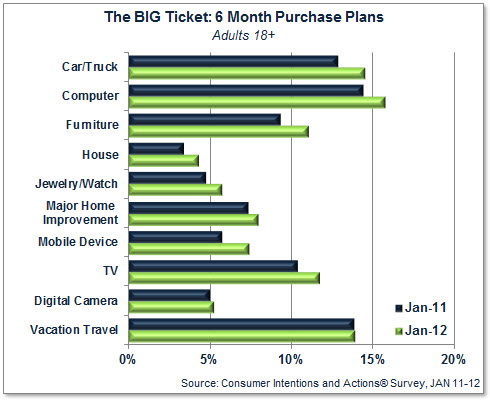
If you've been reading this blog for very long, you know I always look forward to the monthly tracking studies from Phil Rist at Big Research, not only for sales and business reasons but also because they provide great insights for promotions and marketing as well.

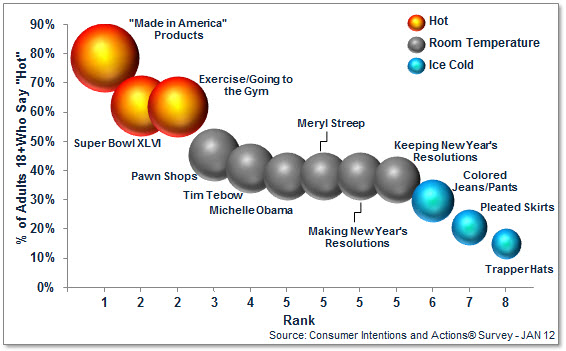
Hot buttons for on air giveaways and content: USA pride, Superbowl and of course that annual resolution to lose weight and get in better shape. But: don't do it in colored jeans, a pleated skirt or trapper hat.

Thursday, January 12, 2012

Interesting Times

For example..

1. A fast-growing ownership group learned yesterday from Miller-Kaplan that they have gone - in just four years - from buying a market's lowest-billing cluster to becoming that city's top-biller in 2011, but still had to work with their lenders to enter bankruptcy because they had the bad timing to have purchased the stations the year before the financial crash of '08.

Going from worst to first in revenues was still not enough to pay the bankers, who - thankfully - cooperated in the restructuring.

2. A longtime major market programmer and air talent who went into music promotion a few years ago lost his job this week when his label owners eliminated their entire promotion staff.

I told him about an on air position with a great company that just opened, but he declined my offer of a recommendation, preferring to continue to pursue work in the record business.

At least he knows where his passion lives and when times are tough, that's the name of the game.

3. Toby Keith's "Red Solo Cup" has sold 1,023,617 digital tracks since its release (ranking #1 again in sales), as almost every single track on this week's digital downloads chart is down roughly 40% from the previous sales week.

Given the state of the economy, I guess we all could use a drink and a good laugh.

Tuesday, January 10, 2012

Peggy Noonan Thought She Was Talking Politics

Her November 19 review of Walter Isaacson’s biography of Steve Jobs in the Wall Street Journal was meant to be a cautionary tale for both political parties, but in rereading it this morning it hit me that she also very succinctly explained what worries me about radio today as well.
There is an arresting moment .. in which Jobs speaks at length about his philosophy of business. He’s at the end of his life and is summing things up. His mission, he says, was plain: to “build an enduring company where people were motivated to make great products.” Then he turned to the rise and fall of various businesses. He has a theory about “why decline happens” at great companies: “The company does a great job, innovates and becomes a monopoly or close to it in some field, and then the quality of the product becomes less important. The company starts valuing the great salesman, because they’re the ones who can move the needle on revenues.” So salesmen are put in charge, and product engineers and designers feel demoted: Their efforts are no longer at the white-hot center of the company’s daily life. They “turn off.” IBM and Xerox, Jobs said, faltered in precisely this way. The salesmen who led the companies were smart and eloquent, but “they didn’t know anything about the product.” In the end this can doom a great company, because what consumers want is good products.

Elegantly package passion into your product, design it to delight listeners.

Once that's as perfect as you can make it, it's time to get sales involved, not before.