Thursday, April 12, 2012

You Don't Have To Have The Highest Ratings

The top ten revenue radio stations nationally, released by BIA/Kelsey yesterday clearly demonstrate that, while being top-ranked in ratings or being in a metropolis is nice to have, it's not essential to being a top biller.

Let's take two recently-released numbers that actually have no "real" relationship to one another and try to coorelate them to see what we can learn with some quick back-of-my-napkin-at-lunch calculations:

WTOP ranks #1 nationally in total revenues from market #8 DC with a 7.5 audience share and is in the top tier of three stations virtually tied in share of audience between a 7.0 and 7.5: $8.5 million per share.

KIIS ranks #2 in revenues from market #2 LA, but is only ranked #3 6+ with a 4.4. Still, KIIS is in that first tier of four Southland stations which have between a 4.2 to a 4.9. Almost $13 million for every share of total audience in the latest monthly.

KFI is #3 nationally in revenue rank, in spite of being #1 in share of total audience with a 4.9 in the latest monthly PPM data. $9.8 million for each of those 4.9 audience shares.

Also in LA, KROQ ranks 7th in national revenues with a 2.7 share of audience 6+ according to the latest month, amidst a group of seven other stations with between that 2.7 and 3.1 in the third tier of PPM-rated stations (the second tier is four with between a 3.6 and a 3.8), with a 2.7. K-Rock, for example, ranks behind Go Country, but out bills the Los Angeles country station, thanks to a big morning show, which is a magnet for young males, managing to bill an incredible $15.6 million per rating share.

WBBM FM & AM ranks behind Chicago's #1 radio station 6+, WGN (5.4) and is tied for #2-#3 with a 4.7, followed by two stations at 4.5. $10.2 million per share.

In New York, the nation's most populous market the top rated 6+ radio station with a 7.3 share is WLTW, but they are actually being out billed by WCBS-AM which has a 2.8 share and also WINS-AM with its 3.5 share. 3.0-share WFAN is only $1.5 million behind. The 6th highest revenues in the USA belong to WHTZ, which notched a 5.2 6+ share last month. Per their latest ARB 6+ share: WLTW = $5,753,424. WCBS = $16,964,285. WINS = $12,000,000. WFAN = $13,500,000. WHTZ = $8.8 million.

Rank by $$ for each 6+ rating share in the latest monthly
  1. WCBS = $16,964,285
  2. KROQ = $15.6 million
  3. WFAN = $13,500,000
  4. KIIS = $13 million
  5. WINS = $12,000,000
  6. WBBM FM & AM = $10.2 million
  7. KFI = $9.8 million
  8. WTOP = $8.5 million
  9. WHTZ = $8.8 million
  10. WLTW = $5,753,424
Obviously, there are more factors involved in great revenues than just share of listening audience.
  • Sell and position aggressively, command the best rates
  • More commercial units per hour (news, talk and sports can carry about 30% more spots)
  • BIG morning show which targets the most-desired demo
  • Men matter; if you can hold onto them, you get the gold
  • Making maximum use of all possible digital assets
  • Be in a high revenue major market
  • Have a very high cume (CHR and AC)
  • Don't target over 55; the younger the better.
Do you have a different read on these stats?

Do you have a plan to grab more than your share of your market's dollars in the next year?


Wednesday, April 11, 2012

In 1989, All It Took Was Seven

In 2012, we have at least 12 so far (in alpha order):

Jason Aldean
Luke Brian
Kenny Chesney
Eric Church
Toby Keith
Lady Antebellum
Miranda Lambert
Tim McGraw
Brad Paisley
Blake Shelton
Taylor Swift
Carrie Underwood
Zac Brown Band

.. and that's not counting Reba, George Strait and a few others who were filling arenas just a year or so ago.

So, the question for me isn't "do we have enough new names who can sell 10,000 tickets on the strength of their own brand power and drive the marketing of country's new generation of music to the new generation of new listeners", but can we possibly find room for any more right now?

No matter how many new artists come through the funnel, we can still only play 14 or 15 songs an hour unless everyone starts releasing 2:30 hits, which would be extremely nice, but shows no signs of happening.

Tuesday, April 10, 2012

"Presumptions Are Holding Us Back"

Catherine Kelly, VP/Western Region for BBM Canada made that statement recently during a day-long session with the Lower Mainland media sales and buying community which was laden with thought-provoking trends and stats.

"One of the largest values with PPM data, yet largely unexplored, is the ability to really get to know your audience and how people use your media. In Radio, we’re still dealing with dayparts that were defined by a methodology designed to measure it…rather than using our new methodology to help us design better stations, campaigns and advertising.

"It is unrealistic to look at old behaviour models and expect that they will continue to apply. 18-24 is the one demo that BBM receives the most questions and concerns about – whether the market or station is measured by diary or PPM. Every research company has issues with A18-24.

"PPM has these:

• Docking – I’m out late and I don’t dock til’ tomorrow
• Females – I couldn’t find a way to wear it with my dress
• CONTACT!!!! – reaching these people is IMPOSSIBLE
• And of course…..“Uhm…I (lost it, dropped it in the toilet/pool/shower/lake, had it but can’t find it, forgot it, left it in my friends car…..)”

"This is Reality…

"The 18-24 year olds THEMSELVES drive variability in audience numbers. They go in and out of the sample quicker and more often than older more ‘stable’ panelists.

"During these years, an 18-24 can experience one or more of these, perhaps several times, all within a year:

• Leave to go to school
• Then come back to parents house for summer
• Leave again
• Get a job, quit a job
• Buy a car, write off a car, etc.

"Nevermind what they can do over the course of 7 years..

"It is often assumed that radio listening and television viewing is a daily habit with slight variability over time. However, when you look at minute, hourly, daily, weekly and monthly data for 18-24 year olds, its clear that variability is the norm for this age group.

"Other factors that contribute: Co-Listening/Co-Viewing. Don’t forget that PPM captures ‘exposure’ and that means there are instances of co-listening or viewing, that are going to occur.

"This is particularly true during ‘holiday’ periods where the likelihood of an A18-24 being in a co-viewing/listening environment increases.

"Market events affect 18-24 year olds and drive variability in audience numbers. (psst..this is true of all demos!)

"Consider the following, especially when examining this group:

• What time of year is it?
• Did this happen last year?
• What could be happening in their lives?
• Market?
• Other media?"


Some folks will say that it must be "be nice to a ratings company day" at Breakfast Blog as I recap this, since I more tend more often to tweek our associates in the media research business given my innate and deeply ingrained sympathies with our programmers, talent and sellers.

However, anyone who shares an abode with an 18-24, a teen or a 25-34 knows that what she's telling us - like it or not - has considerable inconvenient truth in it.

It's time to learn new selling strategies.

Monday, April 09, 2012

If You Don't Understand This, You're Not A Media Buyer Or Planner

"Media is the New Creative", targeting media buyers and planners in English Canada is phase two of the ongoing national multiplatform trade advertising campaign from Canada's Astral Media (click here to watch them all).

The campaign is entirely web based and consists of three videos and one "making of" that all playfully highlight some of the stereotypes of our industry; the messages recognize media planners as the creatives they truly are, but not always recognized for.
Derev Antikacioglu, Director of Branding and Corporate Marketing: "This aims at raising the awareness of media buyers and planners of the near unlimited creative possibilities that Astral offers to reach targeted consumer groups multiple times a day."

Watch 'em and ultimately, I'm betting that like me you need to go back and reread the press release to fully understand what the campaign was trying to communicate ("...that the rapid evolution of today's media landscape is transforming the media planner's role. Media planning and buying has attained creativity in its own right. Being at the table at the onset of the ideation stage, media's involvement in the ideation process is becoming increasingly intimate.")

Here's hoping these creative types don't decide to produce a series designed to "playfully spotlight" the contributions of programming consultants to the biz.

I might have to join that media rep at that bar, just contemplating the possibility.

The mind reels...

Friday, April 06, 2012

Radio Journalism VS PR

When two different trade media cover exactly the same story on the same day, that's not "news," that's reprinting press releases.

There's certainly nothing wrong with a competitor sending out PR each time they close a deal. Both Sirius and XM did it a decade ago. They also bought placement in movies and TV shows, all of which drove a growing impression back then that satellite radio was going to replace terrestrial radio among local business leaders.

"Local radio" is still standing and still wins the battle 10+ to one.

This is not to say that analog radio shouldn't worry about Pandora and all the emerging new media.

It's just to encourage you to tell your success stories in PR as well, while acknowledging that our value proposition on offer to both listeners and media buyers is under attack from new places.

So, what else is new?

Thanks to new media, we have two or three times the inventory to sell that we once did given all the platforms at our disposal.

1. Be sure that our clients get more than the results that expected by being better, more engagingly effective than any competing media's creative.

2. Give listeners more of what they come to us for and less of what they don't. Of course, doing so will mean that traditional "over the air" revenues will be flat to down unless we're able to aggressively raise rates, which in this economy and new media age is an immense challenge.

3. A more sustainable business model is to lower commercial loads "over the air" - making our analog products more listenable - and replace that revenue with money from all possible non-traditional sources.

Long term success requires long term thinking, and courage.

Tuesday, April 03, 2012

Bark If You Want To Cohost A Morning Show

WAXX/Eau Claire's Alex Edwards is in the midst of a very public search for his new co-host and as a part of the promotion he set up a survey for listeners to describe what they want to listen for on radio in the morning.

Ideal Qualities
FUNNY
NICE

What should they be able to do?
TELL GOOD STORIES
UNDERSTAND WHAT LIVING IN WISCONSIN IS ALL ABOUT
TELL FUNNY STORIES
LISTEN TO OTHER PEOPLE WELL
NOT TALK SO MUCH THAT THERE'S STILL TIME FOR LOTS OF MUSIC

What would be ideal hobbies for the next door neighbor?
HUNTING and FISHING
READING
KARAOKE
STOCK CAR RACING

What's the one thing you expect out of the next door neighbor?
MAKE ME LAUGH
MAKE ME SMILE
BE NICE

If the next door neighbor was a dog, what king of dog would it be ?
84 votes LABRADOR
71 votes GOLDEN RETRIEVER
65 votes SCOOBY DOO

Thanks, Alex, for sharing these results with us.

Now, "sit," "fetch," "shake."

Monday, April 02, 2012

Be Nice To Your Voice

For almost a decade back in the 90's, I was a partner in an assistive listening device business and so over the years I received more than my share of professional journals with information of both hearing and speech - subjects of no small interest to me as well, given my lifetime in radio.

In perusing one recently, the Journal of the American Speech/Language and Hearing Association, I found the following piece - reprinted (and adapted a bit) with their permission:

It's baseball season. The excitement of the game and the noise of the crowd make you use your voice at a higher pitch and louder level for a longer period of time than usual.

What you may not realize is that cheering play after play may be damaging your vocal chords.

Yelling at a ballgame is only one way to strain your voice. Singing at very high or very low pitches, smoking, talking in noisy environments, excessive coughing or throat-clearing, or talking excessively can abuse your vocal chords.

When you continue to talk after you have strained your voice, your vocal chord become more irritated. Your voice may sound hoarse or you may have laryngitis. This condition occurs when your vocal chords are so swollen and thick that they cannot produce sound.

Although laryngitis usually goes away after a day or two, you should not ignore the problem. Keep your vocal chords moist with drinks such as lemon, lime or cranberry juice. And try to keep quiet. Don't even whisper!

If resting your voice doesn't work, you may need voice therapy from a speech-language pathologist. In severe cases, you may need surgery.

To keep your voice in good shape for Little League and even World Series cheering later this year:
  • Avoid constant throat-clearing, coughing and loud talking.
  • Don't strain your voice by yelling or lowering the pitch of your voice too much. If you feel strain or tension in your throat, neck or shoulders, you're too loud.
  • Breathe correctly. Sit or stand up straight and breathe from your diaphragm as you speak. Place your hand on your abdomen just below your lungs and speak. You should be able to feel the vibrations if you are properly supporting your voice from your diaphragm. If you are cheering your favorite team, inhale deeply to fill the lower part of your lungs.
  • Go easy on your voice when you have a cold or sound hoarse.
  • Don't try to talk over the problem.
  • Rest your voice. Don't even whisper.
  • Drink lots of clear liquids when your throat is dry.
  • Don't irritate the vocal chords more by smoking or drinking alcoholic beverages.
For more information, contact Consumer Information Division, American Speech-Language-Hearing Association.

Saturday, March 31, 2012

Where To Go From "Perfect?"

I've been listening to a lot of country radio morning personalities lately, as last week's "The Perfect Morning Show" recapped.

For most of us, the quickest path to success is to follow that kind of blueprint, designed to make a lot of local people like you personally by making listeners a big part of everything you do.

Once you've accomplished that, there's a different path which only a very few manage to take, that can create extraordinary long term market dominance.

Make the kind of folks who don't "live" in your community hate you.

That's the only way to take "like" to "love" for the majority of folks who live in your town, and it's a risky path, requiring deep knowledge of local values combined with a degree of unquestioned personal authenticity.

Before you testify to your personal faith journey, question whether Whitney Houston deserves flags to be flown at half-staff or create your own make-believe brand of beer, you must really get to know your own passions as well as those of the majority of your target listeners.

Or, simply take a risk and hope that it works.

Odds are, with that approach, you'll fail, but if you don't, you'll go from "striving for perfection" to "exceptional."

Not many of us have the courage to climb that high or the ability to do it every day, which is why the ones who do so and make it work have audience shares which very few build and maintain.

Thursday, March 29, 2012

Earl Scruggs

Holly Gleason is a Nashville-based writer who has written for Rolling Stone, Spin, Musician, Tower Pulse, Request, Rockbill, Bam, The Illinois Entertainer, Interview, Rock & Soul and Graffiti (Canada). There have been many wonderful obits in the last day for Scruggs, but - as usual - Holly starts with a chance encounter at Waffle House and puts his giant impact on our music in proper context.
Earl Scruggs might’ve been a master musician and innovator of the same caliber as Miles Davis or Coltrane, but he was more a man who sought to bring people together. As a player, his first break came in 1945 with Bill Monroe & His Bluegrass Boys on the Grand Ole Opry, but it wasn’t long until he and Lester Flatt teamed up and spent the 50s and 60s barn storming the country – and creating a true frame for the Appalachian musical form that was all ache and flying fingers. Flatt & Scruggs were icons. Standard-bearers. Gospel-carriers.

Wednesday, March 28, 2012

The Perfect Morning Show

Let's face it. No one is "perfect." Occasionally, some of us attain perfection for a few seconds, a couple minutes. But, perfection that lasts the length of a typical morning show? It rarely happens.

I apologize for the fact that this is starting to sound more like an essay on Buddhist philosophy than a treatise - with examples - of the ingredients of one of those rare morning shows that DOES occasionally approach perfection.

This week, as the Spring ARB is about to begin in diary markets, I have been collecting some excellent country radio examples and bits to share with A&O client programmers - stunning examples of morning perfection - perfect phones, perfect stunts, perfect prep, perfect localization.

Yeah, right.

Truth is, even the best ones aren't "perfect," but they are very good at being themselves in consistent, bigger than life ways.

Bit #1: a clever music relate and backsell on an artist's name. Consistent basics. Station name, show name. The host transitions into a tightly-edited phone bit about a local university holiday.

Their sense of how far to go - allowing the listener to do the 'dirty' stuff and appearing shocked at what he says - is a device that permits the show to deal with more adult material than a country morning show could otherwise. Traffic and forecast, related nicely to the spring allergy relatable.

Then, a segue into their stunt guy, who going to be giving away bras for Mother's Day in May at the area's largest employer. Quite a number of different thoughts in one set, but tightly edited, well-prepped and constant momentum.

Bit #2: Great show biz in the "$1,000 an hour" contest promo. Creative production values, believable listener drops.

Bit #3: They forget the basics - no backsell, no position statement, no station name, no time or weather mentions, BUT - are relentlessly LOCAL - going to a listener on the phone in a community south of town where a big local event is going on.

Not one set without listener involvement in topical, local BIG events. Not 'perfect,' but mighty GOOD.

The set wraps up with three hooks of upcoming songs for a powerful music set into news.

Bit #4: "The news..." and "6:31 now" "that story and all the news comin' up" are hackneyed DJ crutches. A "New Generation/Millentials Country" station would be more effective either doing street talk or at least avoiding the jocktalk words.

Bit #5: "Things you need to know." That big local event going on now. Sex harassment at youth services. Coffee shop murder. FBI search for Florida shooting facts. Cell phone risk. Donut cologne. Good story count and story variety. Leads with local, ends with human news, everything sounds like it's the latest info on something happening right now, no rehash of last night's TV news.

Bit #6: Bra giveaway phone bit - stunt guy cut-in. They should have planned where he was going BEFORE asking about it on the air, but they are very tightly edited and exhibit good equal involvement of all characters and viewpoints.

There is almost nothing that happens on today's show that doesn't reflect a 'big event' in local lives (gax prices, planning for what to do getting ready for Mother's Day, Bra) and do it making use of real listener phone calls.

In fact, using two listeners to describe the ongoing local big local event this morning is no doubt due to the need for economy, but it also strengthens their impact and relatability.

This huge positive makes me 'forgive' the occasional lapses in basics and other imperfections.

Other good elements of this typical day's show: Random Poll (Gas prices), one of the hosts spoke to business English class yesterday and got the mention of the appearance in naturally as a part of the phone poll.

I love the way they appear to have a great rapport with phones, edit them tightly and incorporate them effortlessly into everything they do, without losing topical and local top of mind content.

The stunt guy has great inflections, gets lots of meaning into every phrase.

It's almost too much of a coincidence that two callers in one hour happen to be watching the ongoing big local event. Obviously, they are prearranging these calls, but they sound perfectly spontaneous.

Follow-up phone call from girl who was reunited with her father was another example of this.

Lots of heart, emotion and storytelling in every break.

Great promos: "(market) #1's Country" music menu production ID, "the station you have dialed in," "$1,000 phone calls" is handled VERY well, sounding fresh and immediate and freshly-updated daily jock cross promote to midday.

Mother's Day remote morning show broadcast at the big local Mall is already being pre-promoted. You feel like it's going to be big, fun and if you're celebrating it, THEY are celebrating it.

Things I think they could do to improve: They tend to neglect the basics - time, weather mentions, position statement, station name first thing into and out of music far too often. Doing these things improves memorability, thus ratings, and services listener needs. So, why NOT do them consistently?

They aren't consistently back announcing titles and artists of the songs. Music relate is extremely important to all country listeners, especially country fans. On one hand, maybe they are over-reacting to PPM (find ways to abbreviate these items but don't fail to do them) and yet on the other, The Random Poll gas price phone calls went on too long.

They were good, but I thought 30 minutes on the one topic was too one-dimensional, dubious the average listeners would have been able to hear the entire conversational thread in a world of 2:30 listening occasions.

Too many unrelated thoughts per set - perhaps the worst example: going from the Mother's Day brunch promo into a bit about a new artist's album. They got into advocacy on the gas price phone calls, which elicits somewhat irresponsible callers which should not have been aired.

Overall: it's definitely NOT perfect. But it's a pretty good example of a darn good day on a darn good morning show. If you didn't find a few ideas to borrow for YOUR morning show, perhaps YOU should send me an mp3.

Maybe YOU are the perfect one?

Tuesday, March 27, 2012

I'll Show Your Mine, If You Show Me Yours

Charlie Cook writes a thought-provoking column each Friday for Music Row Magazine Online.

Twice a year, before the CMA show and the ACM show, he reaches out and asks for opinions of the industry. This week he's asked "what you think of where we are right now or where you think that we're headed.."

Here's mine:
One of country's greatest strengths remains more true than ever - the fact that older listeners whose tastes in music on radio otherwise are all songs from their youth love both the newest music and also their all time favorites. As always, the young side of our target isn't as fond of the country hits from much longer than 3-5 years ago. And, when those moons align - as they have done for the last two years - we get an exciting new group of superstars which drives growth. Lady Antebellum, Zac Brown Band, Blake Shelton, Carrie Underwood, Jason Aldean, Taylor Swift and Luke Brian, for example, are more than enough to build a new format on, while some very savvy heritage superstars like Brad Paisley, Toby Keith and Tim McGraw have found songs that have kept them in the mix as well. Boom years used to last five to seven years, but everything moves so fast in this culture, the question now is how long will this last? Will it be like the early 1990's boom? Or, more like the brief one in 2006, which peaked in just over one year? Thanks to the fact that all of our "new big seven" stars are all doing exceedingly well in touring, as are many if the historical stars, I am optimistic that as long as we don't push too much mediocre music at listeners, we're going to have a good run, driven this time by the emergence of Generation Y, the largest generation in American history, whose values are going to drive everything for the next decade or so. If you don't understand those values, it is going to pass you by. To learn about them, simply listen to the lyrics of the hits that test well with target listeners.

He promises to weave these thoughts in with all the others this coming Friday. I can't wait to see the tapestry containing many threads that everyone else is thinking!

Friday, March 23, 2012

Your Cume Needs To Be 30% Higher

Coleman compared a full year of audience data on 13 "High Performance Stations" -- so designated because their Adults 18-49 audience shares were significantly larger than the shares of competing stations -- to 68 other stations in Calgary, Edmonton, Montreal, Toronto and Vancouver using InfoSys+ radio software from BBM Analytics.

Among other findings, this comparison revealed that:
  • The average Daily Cume Rating of the High Performance Stations was 130% higher than the average for the non-High Performance Stations
  • High Performance Stations achieved slightly higher Time Spent Listening levels, primarily because they generate an average of 5.6 listening sessions per day, 15% more than the 4.9 average number of daily listening sessions generated by non-High Performance Stations
  • At 69.9%, the proportion of listening High Performance Stations generate out-of-home is higher than the 62.9% of listening generated out-of-home by non-High Performance stations
"Our findings are similar to those we uncovered in a similar analysis of American PPM data in 2009" said Coleman Insights VP Doug Hyde, who authored the study. "They support the idea that those radio stations that are well-known, have clearly-defined positions and have brand attributes that listeners want to affiliate with are the most likely to perform well under PPM measurement."

I find it sadly ironic that
BBM Analytics' blog still includes a link to a very nice concept "Creating Passionate Users" since the very radio formats with the most passionate users are the ones which tend to do worst in PPM measurement due to the too-small sample sizes where the only number they seem to be able to track reliably is 6+ cume. You'd think that the ratings firms who do the measurement would understand that by now, but it seems that they do not. (3/26: be sure to read the comments, where I am called to task for stretching a blog link into a point at least one step too far and I apologize to BBM for it, then try to explain why I am so worried about this issue)

Yes, at a time when media fragmentation is the megatrend, it would be very nice if radio's audience measurement system wasn't crushing radio stations with small, but loyal and reponsive audiences, but that's simply not the way it is. Listeners look to radio for more diversity and variety now and yet PPM's tiny (compared to what would be ideal) panel samples reward just the opposite.

Forget about "passionate users" until PPM samples double or triple. Until then, it's all about cume, cume, cume.

Thursday, March 22, 2012

"We Run Everything Through The ‘Is it Good Enough For The CMA Aircheck?’ Filter."

"... If it isn’t, we don’t put it on the air. " - Lisa McKay, station manager of Curtis Media's WQDR, Raleigh/Durham (Large Market Radio Station of the Year)

WQDR's "Award Winners' Share Success Strategies" as told in February-March CMA Closeup Magazine to writer Brad Schmitt:


It’s all about connection to the audience and the three M’s: music, morning show and marketing.

Twice a year we run TV campaigns with 300 grps a week to talk about the radio station and to cement our relationship with current listeners as well as to get listeners from the AC (adult contemporary) and pop radio station.

We pre-produce a tremendous amount. We do a lot of re-purposing for the things we think are really good to recycle them later in the day.

We’ll tape artist interviews days in advance and run short segments in the morning show. We always look for something that’s a hot button for our listeners, whether it’s gas or money or experiences they can’t get anywhere else. everything we do is listener-focused. I think that, in a nutshell, is how we won.

(The internet has) given us a new revenue stream for selling ads and sponsorships on the Web page. But it all goes back to making your listeners feel connected and that they’re the stars.

Every last one of our personalities, even our part-time ones, is an administrator. Anytime anything happens that we find qDR-worthy, we’ll pop it up on our Facebook page.

Part of the station’s personality is being well-rounded. To connect with listeners, you need to connect with what’s important to them — and that’s children and homeless animals and people who have fallen into bad times. Whatever is local to the community needs to be addressed on the air.

We do a fundraiser for our children’s hospital (for just one example). We broadcast live all day and we put on a pretty large concert, which usually generates about $100,000 for this particular hospital. We’ve been doing it for 10 years. It’s a really big deal.

We also do our own Christmas wish program. It’s actually our Christmas present to each other. We never exchange gifts because we allow our listeners to nominate families in need. Then we post the information on the website, enough so that people can connect with them and either feel better that their life isn’t so bad or actually reach out and make a difference to somebody in a real way. A lot of times, it’s a family whose house burned down and they need a kitchen table. every radio station has a listener with an extra kitchen table, so it’s a really neat way for listeners to connect with each other through the station.

Even if the person can’t give anything, at least they can say a prayer for the kids. People want to make a difference, whether it’s with money or with their thoughts.

Wednesday, March 21, 2012

"Changing The Way You Focus On Things"

We focus a lot on our community and what’s going on in our town. Of course, we hit the national pop culture stories too, but we’re very locally focused, very interactive with our listeners whether on the phone or online.
Once a week, the Humane Society comes in with a new pet. We take a video, put it up on the website and Facebook page and we talk about it.

And, we have a 100 percent adoption rate! Every week, that critter gets adopted.

I feel like the percentage of listeners who call you is so small. With social media, they’re more comfortable talking with you online. even people who just kind of listen to us will take time to look at our Facebook page, to see our pictures, to make a comment and to like us.

And, the fact that we interact back creates a stronger bond; it makes them more likely to become our P1s.

-- Scotty Cox and Carissa Loethen of KCLR, Columbia. (Small Market Broadcast Personality of the Year) to Brad Schmitt in CMA CloseUp

Tuesday, March 20, 2012

In CMA CloseUp: "Just Be Yourself"

Michaels: We’ve been doing a team show for 20 years. We’ve been married for 17 of those. So it’s really easy for us to know what the other one is thinking and read each other really well.

We try not to have any secrets … well, maybe some secrets. We try not to hold back from our listeners and just let them have our day-to-day life. Surprisingly, we learned many years ago, our life parallels theirs. So it’s just being real and living in the real world. It’s reality radio.

Pierce: It is so easy to go in over-prepped every day. I go in with enough stuff to do six shows every day. you’ve got to be ready to throw it all out and do something better if it comes up and is in the moment. I’m doing a break at 6:10 in the morning that I can’t do at 8:10. It wouldn’t work at 9 and it wouldn’t work at 7.

If you’re riding that crest of the moment, right here, right now, it’s a lot easier to connect with people. That means coming in with fantastic material that you might sit on for two weeks.

Pierce: Radio people need to drive the car. The radio station is the car. It’s so easy for us to put that sucker in auto and walk away. But I can do any segue, drop or anything better manually than a computer, every time. you can’t put your finger on it, but why does this guy sound better than that guy? Because he’s driving the car.

Michaels: We get a lot of artist (interviews), but we don’t do them all. We’re selective. Sometimes we pass them down to the midday show. We’re on morning drive, so it’s tough to fit in interviewing someone. And we never do live. I did live once — bad idea. Don’t do it. Sometimes you have to work to get them where you need them to be if they’re not in the live frame of mind. Schedule artist interviews in the 9 o’clock hour and play them the next day.

Pierce: The biggest thing we’ve done is a Christmas in a Box program. It started quite organically. Kellie went on the radio quite innocently 10 years ago, with something as simple as, “Boy, wouldn’t it be great if we could get some boxes and send them to the troops overseas?”

We literally mentioned it on the air one time and the phone rang. The caller said, “Can I bring some things by the radio station?” We said, “Well, sure. We’ll put them in a box, we’ll pay and send ‘em over.” A half-hour later, we told that story. People heard it, one thing led to another and — this is no exaggeration — four breaks on the radio filled a bedroom in my house.

- Kellie Michaels and Brian Pierce of “Mornings with Brian and Kellie,” KFDI, Wichita (Medium Market Broadcast Personality of the Year) to Brad Schmitt with insights from the CMA Broadcast Award winners on what it takes to score a national award

Monday, March 19, 2012

Make The Most Of Your Free CMA "Year Of Radio" Membership

CMA’s commitment to Country radio is long and enduring, dating back to the origins of the Association and continuing through today.

This year, CMA takes that commitment to a new level with exclusive content, promotions, research tools and more. It's possible that your membership credentials arrived too late for you to see a copy of February-March CMA Closeup Magazine.

If that's the case, I hope you'll enjoy this quick reprise of quotes from a terrific two page article by Brad Schmitt with insights from the CMA Broadcast Award winners on what it takes to score a national award which I plan to reprise here this week, starting with:

I think radio should try to make ‘em happy, make ‘em cry, make ‘em mad, make ‘em sigh. We just try to get emotions out of them, make them passionate, get them to show up for your causes, get them to show up at your events and do things on the air that inspire reaction. Get them to
call in with their comments. Make radio valuable. Give them what Pandora can’t give them. Give them what the Internet can’t give them. Give them all these great options they can’t find anywhere else.

Do things on the air that will inspire reaction. We have an open mic segment twice every morning. They call in and we don’t interfere, but we’ll throw in sound effects and clips. They can rip us, they can argue with us, they can call in and congratulate us on a CMA win.

They can do whatever, and we try to keep it entertaining. Make it a radio blog! Let them know they’re welcome to be a part of it, participate in it and have fun.

-- Chris Carr of “Chris Carr & Company,” WUBE, Cincinnati, Ohio (Large Market Broadcast Personality of the Year)

Friday, March 16, 2012

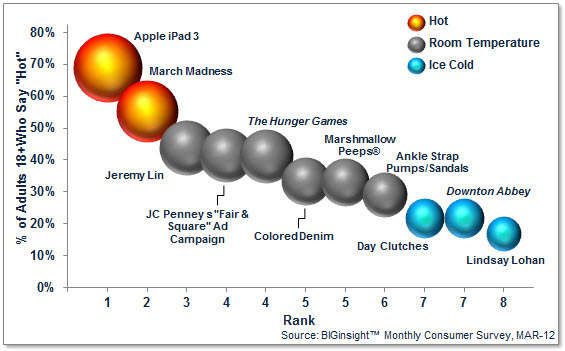
Hot: IPad3 + March Madness

What’s Not? Big Research names Lindsay Lohan…while Debbie Harry’s [alleged] doppelganger was a hoot in The Real Housewives of Disney sketch on SNL, adults in general just aren’t ready for this comeback – and that’s no laughing matter.

Thursday, March 15, 2012

So Close, Yet So Far To Go

It looks exciting, making you wish that your ARB diary market sample could be so consistent, but there's a catch.

Inside Radio's report this morning may have left you wanting more info if you weren't on yesterday's Arbitron webinar.
E-diary plans hit a familiar snag. Project Leapfrog is how Arbitron refers to the R&D phase of its new electronic ratings diary but the amphibian’s jumping legs have hit a familiar snag: low response rates. But the effort may also offer some promising fixes too. In testing the experimental electronic diary produced a more representative sample.

I was on the webinar representing A&O clients and if you couldn't make it, here's my recap (pdf).


Tuesday, March 13, 2012

Break Off The Knob?

Yesterday, I shared the bullet point that Canadian country radio listeners are slightly less satisfied with their favorite country station than Americans are. (could that be because so many American country listeners have choices between more than one and in Canada there is no market with two competing FM country stations?)

Here is the other side of that coin and it’s great news for Canada’s country radio stations.

When asked how likely they would be to switch to something new, the Canadian listeners feel that it would be harder for a new radio station to get them to do so.

A&O Roadmap 2012: The Rolling Stones Were Wrong

AO client perceptual Roadmap 2012 (client only logins required) national averages, total sample satisfaction levels with country radio's product have been trending upward for the past four years in a row. Canada turns the tables and does better than the U.S. in yet another important stat, "switchability."

That additional little gem of positive info posts here tomorrow.

Monday, March 12, 2012

Loud And Proud

Canny Bob Wood, who always seems to be 'the friend who has the best audio gear' in my address book has golden ears. He just passed along a notice of this week's "Dynamic Range Day."

Given the popularity of the mp3 and Pandora's HE-AAC compression, I find it hard to agree that most folks can hear the difference and still believe that the biggest, loudest radio station on the dial wins the ratings too.

Audiophiles talk about grunge hurting time spend listening, but I have been tracking Arbitron and BMM stats for decades and have never seen any coorelation between loudness and weak TSL.

How about you?

In the battle between Orban, Wheatstone and Omnia, I cheer for all of them to keep pushing the boundaries of the psychology of sound to help leading radio stations continue to SOUND like leaders, when compared to everything else on the dial.

If it's been awhile since you have compared what's available, it's time to do so.

Which one do you prefer these days? Or, is their a mysterious black box in your audio chain that you'd prefer not to talk about?

Saturday, March 10, 2012

Even Our Best Friends Do It

A&O loves Radio Ink. I have subscribed for many years, through thick (issues) and thin (ones too). Publisher Eric Rhoads, one of radio's biggest cheerleaders, has spoken at our client seminar going back to the days when it was at the Opryland Hotel 15+ years ago. We buy ads in it because we know that the people we need to reach read it. In fact, we did so in last month's Country Radio Seminar special edition.

So, Radio Ink, do me a favor and drop the hay bales.

Get the latest Arbitron Radio Today report and go to pages 15-19. If you have access to local qualitative, so much the better. Let's get relatable to today's country radio audience.
Country consumers are becoming increasingly well educated at the university level, with about one in six adult Country listeners having earned a college degree. The format’s 16.3% college graduate level in Fall ’10 was the highest reported in the past nine years, and the 89% proportion as high school graduates was also a nine-year high. Nearly half of adult Country listeners resided in households earning at least $50,000 per year, a figure that remained consistent between Fall ’09 and Fall ’10.

And, while I'm at it, Nashville song writers, artists and label execs, can you please do so as well?

A lot more of our fan base lives in cities than resides up in a "holler."

Let's relate more consistently to 18-49 and 25-54's real lives in our music and marketing than to their fantasies of escaping their busy, over-committed lives to a non-existent imaginary small town.

Country certainly encompasses pick up trucks, hunting and fishing, but at its most broadly appealing it's always been about the real life universals which unite all of us.

Thursday, March 08, 2012

Questionable Advice

1. In the March 26th issue of Radio Ink magazine, the Director of Media and Digital Marketing for La Quinta Inn, Amy Bartle tells radio that our stopsets are too long.

We train our sellers to really understand the buyers' business needs before pitching our wares, but it always seems that media buyers are at the ready to tell us how to run our businesses.

They are only one set of our customers and if their suggestions to stop promoting long sets of content listeners love were taken, we'd deliver fewer sets of ears to hear their ads.

Suggestion: if you want to be the only commercial in a cluster, pay a higher rate and if you pay enough we'd be happy to make your spot the only one we play. But, of course, that would be wasteful, given radio's efficiency and research-proven ability to hold listeners through stopsets.

Focus on creating more engaging commercials and they'll be up to 40% more effective for the same money, no matter where they run.

You want to see clutter? Read your newspaper or watch TV.

Your spot on radio is at center stage when it's on and, unlike TV, most listeners don't skip it.

2. In comments filed with the FCC for its media ownership proceeding, NAB says the current caps, tiered by market size, as well as the AM/FM subcaps that limit how many stations of one service a group can own in a market can no longer be justified and no longer serve the agency’s diversity policy goals.

Small broadcasters have no representation in Washington other than the NAB and perhaps their state broadcasting association, whereas Clear Channel reportedly spends $700,000 annually on their four lobbying firms.

Did the NAB really need to provide stats from Clear Channel as part of their filing?

Certainly, the big guys exert powerful influence on NAB, but hopefully the thousands of small business local owners across America the organization also speaks for got a chance to share their views on further consolidation as well.

I am not necessarily against revisiting the ownership caps, especially when it comes to newspaper crossownership - since many local newspapers have been great stewards of their radio licenses over the entire history of our medium, often providing better local news and public affairs than anyone else in town - but I do wish the NAB's filing had included supportive comments from many of them, instead of CBS and Clear Channel.

Monday, March 05, 2012

Not Able To Be At CRS? Catch Up On What You Missed

Conduct your own Country Radio Seminar: all of the panel handouts are now available (most are free and require no logins) by clicking here.

Hear most of the sessions as digital downloads (click to order)

Especially worth your time are the videos of the one to one interviews about how out listeners feel about and use country music and radio. Click to watch:
  • What do you love most about Country? Video 1
  • How long have you been listening to Country? Video 2
  • Old Country vs. New Country Video 3
  • Lyrics & Themes Video 4
  • What does Country music mean to you? Video 5
  • Country Crossover Video 6
  • “Twang” Video 7
More videos are at Edison Research's website.

I know it's a lot to watch, but I would not be a consultant if I didn't nag a bit.

1. Your competition is probably viewing them right now.
2. Plan now to put what you learn from it on your radio station now.

Mike Catherwood On Radio Vs TV

The 32-year old started as a van driver and promotions assistant at KROQ-FM a decade ago, has Danced With Stars (beaten by Wendy Williams), filled in for Regis Philbin on Live! with Regis and Kelly, hosts Loveline five nights and week and he just sat down with Mediabistro for a very revealing interview.

Ponder these thoughts:
  • "...radio is an incredibly anonymous industry."
  • "The intimacy you develop with your fan base in radio … there's nothing you can compare to that. You could be on the most popular television show in the world, but if you're on a show like Kevin & Bean, which I was lucky enough to grow up on really, the listeners are like your buddies. They drive to work with you every day. They know every intimate detail in your life, the ins and outs of it. There's no TV show like that. It's totally unfiltered. You don't have four or five producers trying to manipulate what you say and how you say it, which you do in TV. The immediacy and the genuine nature of radio is what I love about it."

Thursday, March 01, 2012

Good Intentions (From A&O's 'Trachman Files)

I suspect a lazy streak runs through most creative people. We tell the world we're looking for a *better* way to do things, but what we're really after, deep down, is an *easier* way. Why else would we choose a profession which, at least from the outside, looks like the easiest of all? To get paid for simply talking; to sit and listen to music for several hours a day -- tell me that isn't a large part of what drew you to this Biz... No matter that you soon found out it's more complicated than that -- by then we were stuck, committed, and yet, beneath it all, still questing for that ideal on-air job, where they pay you more than you can spend, just for being yourself
behind a mike...

More evidence of our laziness: we pay lip service to many wonderful ideas that never get put into practice. I teach DJs how to prepare material for their shows; they almost always agree that this is a good idea. Yet, if, months later, I ask to see their prep sheets, not one in ten will be doing
any...

I invite talents on client stations to send me tapes so we can critique them together. On the phone, they respond like I have just offered them part of my soul. Four out of five never send the tape and of those who do, it can be months before we find an hour to spend together listening to it.

I urge PDs to critique their jocks regularly, and there isn't one who's ever said to me, "That's a low priority; maybe I'll get around to it some day when I have time." And yet -- well, you know...

I present workshops at radio stations, and when they're over, often I'm walking on air, delighted at how well my ideas were received. As if to underscore my perception, they invite me back months later to do it again.

They can't have been just "shining me on" -- they're spending money to have me return! But when I arrive, I often wonder if I've ever been there. None of those bright ideas have actually been embraced. Nobody's doing any real show prep, the PD has never gotten around to critiquing on a regular basis and the station sounds pretty much as it did before...

What gives?

I think it's that lazy streak I referred to earlier. I don't mean this in a judgmental way and I most certainly include myself in the group. I could tell you a hundred things I should have done over the past ten years, that I just never got around to. Is there an answer? Or are we doomed to continue sliding by with a minimum of effort, following the path of least resistance on down to oblivion? When they say the road to hell is paved with good intentions, this must be what they mean...

The antidote is already well known to your sales and management colleagues, although they may have different names for it: rational selfishness; identifying your own, long-term best interests, and acting on them.

It is in your own selfish interest to prep material for your show. That's how you become the sort of personality that draws people back to hear more.

That's how you advance your on-air career, survive "house-cleanings," get better jobs, earn more money. If that doesn't motivate you, then you're not just lazy, you're plumb self-destructive!

It is in your best interest to get critiquing, and if you can't get it from the PD or from me, get it from someone else; a colleague, a spouse, even your child. Maybe you know more about radio than they do -- so what? "Wise men learn more from fools than fools ever learn from wise men."

The truth is, performing requires a different set of talents than coaching or critiquing. All great performers have coaches or directors.

If you're a PD, coaching/critiquing your air staff -- helping a major component of your product to improve -- should be one of your highest priorities, not your lowest. It's one of the key ways you get ratings, and that can only benefit your station and thus, you, personally, in the long
run.

Our native laziness may help us to be creative, to be clever, but it's self-defeating when it gets in the way of delivering the efforts required to achieve success. Are there things you know you should be doing to benefit yourself in the long run?

When do you plan to start?

-- Written and distributed by my hero Jay Trachman on August 26, 2002. Ten years ago and really only the references to 'tape' make it sound anything but completely relevant today.

Wednesday, February 29, 2012

Take The Gift And Make The Most Of It

CMA used the annual gathering of radio representatives from across the country known as CRS last week to announce that the organization is awarding complimentary organizational and two individual memberships to every Country Music radio station in the United States for one year. The free radio memberships are a cornerstone of CMA’s “Year of Country Radio” campaign, said CMA Chief Executive Officer Steve Moore.


“Country radio stations and broadcast professionals do an outstanding job of broadening the scope of Country Music and presenting artists to their listeners,” said Moore. “Country radio is on the front line of the format expanding the careers of established artists; creating and developing awareness of new talent; and delivering music directly to the fans that support our business.”


Obviously the strength and vitality of Country radio has a direct influence on the industry. And CMA values the significant impact of these radio professionals and honors their talent and creativity each year with the presentation of the CMA Broadcast Personality and Station of the Year Awards as part of the annual CMA Awards, which is recognized as Country Music’s Biggest Night(tm).


In 2012, CMA has prioritized its support of this important constituent group with the “Year of Country Radio.” In addition to complimentary membership for 2,033 Country radio stations, member stations will have access to more CMA research, online content, promotional opportunities, and other services than ever before.

“We are going to examine each of our touchstones with radio and approach everything we do with an eye toward being inclusive of all stations,” said Brandi Simms, Senior Manager of Membership and Balloting.


CMA will send membership kits to stations this week with information about the tools and resources available including medical insurance, telecommunications discounts, research, and the ability to vote for the annual CMA Awards. In addition to an organizational membership for each station (valued at $200 each), the program director and general manager at each station will be provided a complimentary individual memberships (valued at $100 each). Any current CMA radio member will be given an additional year of membership in the organization.


“Country radio professionals are among our best ambassadors and it is important for CMA to recognize their outstanding contributions to the Country Music format and make the vast resources of CMA available to support their efforts,” Moore said.

“Enabling every Country station in the U.S. to be a member of the organization provides CMA the opportunity to gain valuable insights from this important constituency group that we can use to better our services to them and support the growth of the format,” added CMA Vice President of Marketing Tammy Donham. “Everything we do is about promoting the genre worldwide and we want to work collaboratively with our friends at Country radio to extend not only the reach of CMA events, but to develop the fan base for the benefit of all.”


The ACM did a similar thing several years ago and it was distressing to see how few stations took advantage of it.


These organizations are country music's Chamber Of Commerce and I can't imagine no matter how busy we all are that anyone serious about advancing in country music and radio that the great work they both do isn't self-evident.


Get involved. This is your free, one year opportunity to take advantage of getting an inside view of all that CMA does.


Thank you, CMA for doing something "huge" to let radio know how important broadcasting is to you. I hope radio responds in an equally BIG way!

Sunday, February 26, 2012

Three Very Smart CRS Quotes To Save

"We don't call it social media, we call it 'the audience.'" - Dermot McCormack Executive Vice President, Digital Media, MTV Networks Music & Logo Group

"If it sells (Jaye adds: and you know it's selling to potential P-1's of your station!), it's a hit. If it researches (JA: with your target listeners!), it's a hit. If it does both, it's a huge hit. If it doesn't do either one, stop clogging up the system with it." - Tom Baldrica, President, Average Joes Entertainment

Let's face it: just because you're doing 14 different jobs doesn't mean you're multi-tasking. Successful multi-tasking means prioritizing and only doing what hits your goal.

1. Use the same authentic, real voice you'd use when you talk to a friend when you post and comment in all social media.

2. Stop propping up songs on your playlist that aren't selling and are not researching with your listeners.

Finally, I can't add a single thing to new Universal Music Group CEO Mike Dungan's CRS week quote in his Tennessean interview: "I think the best radio comes from someone who understands you, the listener, a fun and entertaining neighbor who is always there, bringing you the cool stuff. There are some radio stations out there that are masters of that. Then there are others that resonate just like corporate wallpaper."

The next ratings month is just around the corner. Give your listener nothing but your very best.